
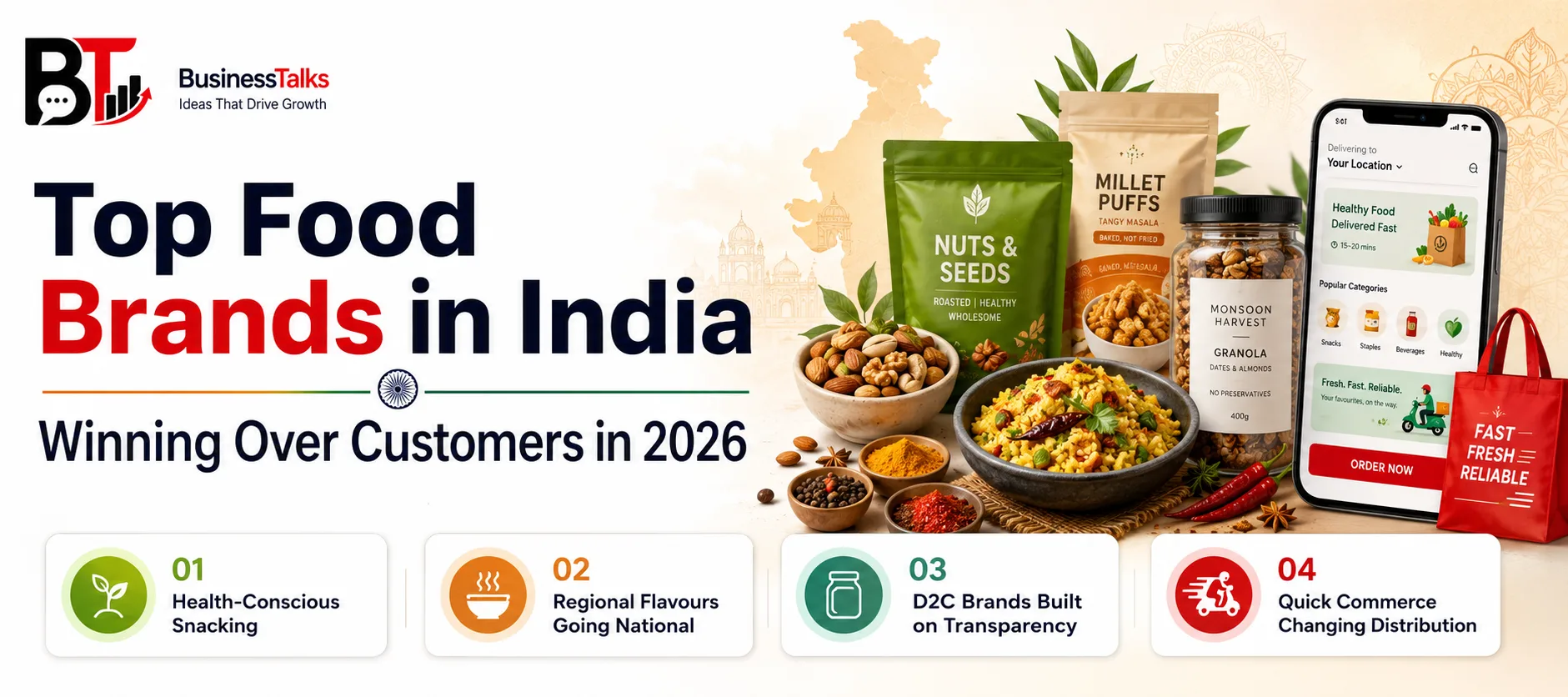
India's food industry has changed shape dramatically over the last few years. What used to be a market dominated by a handful of large FMCG players now includes hundreds of direct-to-consumer brands competing on flavour, health positioning, and storytelling. In 2026, the brands that are winning aren't necessarily the ones with the biggest ad budgets — they're the ones that understand what today's Indian consumer actually wants.
At BusinessTalks.in, we track these shifts closely because they say a lot about consumer behaviour more broadly. This article looks at the categories seeing the fastest brand growth, what's driving customer loyalty, and what smaller food businesses can learn from the brands rising to the top.
The Shift Toward Health-Conscious Snacking
Perhaps the biggest change in the last few years has been the rise of "better-for-you" snacking. Brands built around baked instead of fried snacks, millet-based products, and reduced-sugar options have moved from niche health stores into mainstream supermarkets. This isn't just an urban, high-income trend anymore — tier 2 and tier 3 cities are increasingly driving demand too.
Regional Flavours Going National
Another notable trend is regional food brands scaling nationally by leaning into their local identity rather than diluting it. Products rooted in specific regional cuisines — South Indian filter coffee, Bengali sweets, Rajasthani snacks — are finding audiences far outside their home states, helped enormously by e-commerce and social media discovery.
D2C Brands Built on Transparency
Consumers today read ingredient labels more carefully than they used to, and brands that lead with transparency — clear sourcing, honest nutrition information, no hidden additives — tend to build stronger trust. This has become a genuine competitive advantage, not just a marketing angle.
Quick Commerce Changing Distribution
The explosive growth of 10-15 minute delivery apps has reshaped how food brands think about packaging, shelf life, and even portion sizes. Brands that adapted their packaging for quick commerce visibility — bold colours, clear branding, prominent claims — have benefited from significantly higher impulse purchase rates.
Market Comparison
To put this in perspective, here's a simplified look at how consumer interest has shifted across a few key food categories over the past three years, based on general market observation rather than any single proprietary dataset.
Healthy Snacks
Regional Foods
Ready-to-Eat
Beverages
Frozen Foods
Bar height represents relative growth in consumer search and purchase interest, not exact market share figures.
What Smaller Food Brands Can Learn
You don't need a national ad campaign to build a loyal following. Several of the fastest-growing food brands started with a tightly defined niche — one product, one clear promise — before expanding their range. A few patterns stand out:
- Consistency over novelty: Customers return for a product that tastes the same every single time, not for constant reinvention.
- Packaging as a first impression: On a crowded shelf or app screen, design often decides whether a product even gets picked up.
- Community-driven feedback: Brands that actively listen to customer comments and adjust recipes accordingly build stronger repeat purchase habits.
- Honest storytelling: Sharing the real story behind a recipe or a founder's journey resonates far more than generic marketing copy.
The Role of Local Sourcing
Brands that highlight local or seasonal sourcing — a specific region's rice, a particular district's spices — tend to earn a kind of trust that's hard to manufacture through advertising alone. It also often means better margins for local farmers and producers, which is increasingly something conscious consumers care about when choosing between similar products.
The Growing Importance of Reviews and Word of Mouth
Unlike a decade ago, when shelf placement and television advertising decided most purchase decisions, today a large share of food purchases — especially first-time trials — are influenced by reviews, ratings, and short videos from other customers. A single well-made recipe video showing how a product is used can drive more trial purchases than a month of traditional advertising. This has levelled the playing field considerably: a small brand with a genuinely good product and an engaged community can outperform a much larger competitor with a bigger budget but weaker word of mouth.
This also means customer service and product consistency matter more than ever, because a single bad experience can spread just as quickly as a good one. Brands that respond quickly to complaints and treat negative feedback as useful information, rather than something to hide, tend to recover trust faster and often turn unhappy customers into advocates.
Where This Is Heading
Expect the next couple of years to bring even more fragmentation, with smaller, focused brands continuing to chip away at categories once dominated by a few large players. At the same time, some of today's D2C darlings will likely get acquired by larger FMCG companies looking to plug gaps in their own portfolios — a pattern we've already seen play out in adjacent markets.
Conclusion
India's food and brand landscape in 2026 rewards authenticity, consistency, and a genuine understanding of local taste. Whether you're a founder building a food brand or simply a curious consumer, keeping an eye on these shifts tells you a lot about where the broader market is headed. For more brand breakdowns and case studies, browse our Food & Brands section, or explore Local Businesses for stories closer to home.