
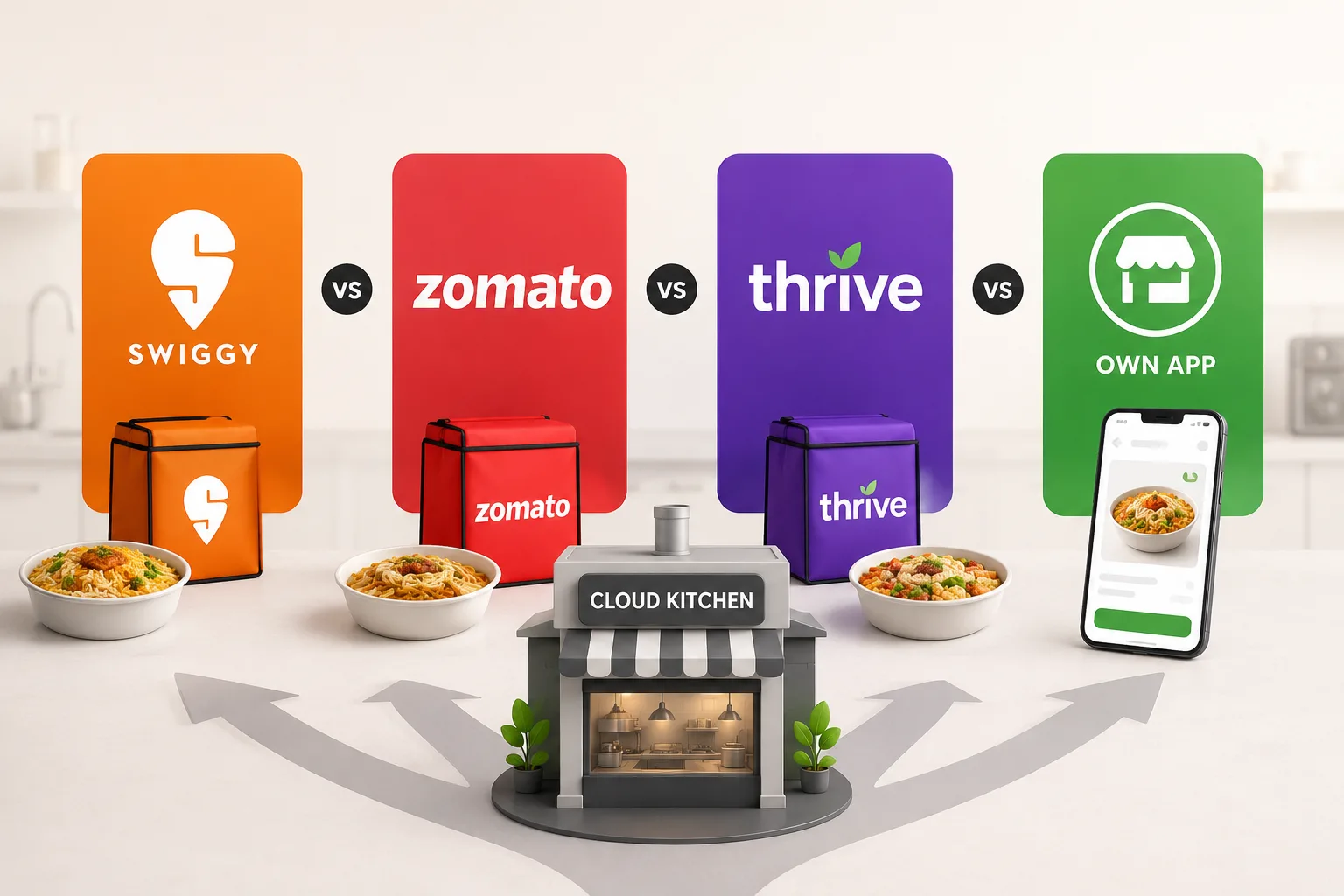
Starting a cloud kitchen is one of the most accessible food business models in India right now — low overhead, no dine-in pressure, and a massive built-in customer base through delivery platforms. But one of the earliest and most critical decisions you'll make is: which platform do you actually list on?
This isn't a simple question. Each platform comes with its own commission structure, customer demographics, kitchen support, and growth potential. The right answer depends on your city, your food category, your margins, and how much customer ownership you want long-term.
Let's break it down properly so you can make an informed decision before signing any agreement.
The Main Platforms You Need to Evaluate
1. Swiggy
Swiggy remains India's dominant food delivery platform by order volume in most metro cities. Listing on Swiggy gives you access to a large, high-frequency customer base — people who order 3–4 times a week. Their Swiggy Access programme offers shared kitchen infrastructure in select cities, which is useful if you want to enter a new market without committing to physical space upfront.
Commission range: 20–25% on every order, plus packaging and promotional charges in some configurations. Swiggy also runs platform-wide discount programmes — participate carefully, as these reduce your already-thin margins.
Best for: High-volume cloud kitchens in Tier 1 cities where Swiggy's user base is largest. Works especially well for QSR-style menus with fast preparation times.
2. Zomato
Zomato's strength is its restaurant discovery ecosystem. Customers frequently browse Zomato before deciding what to eat, which gives newer brands better discoverability than Swiggy for search-based orders. Zomato Hyperpure also gives listed partners access to quality ingredients at competitive pricing — a supply chain advantage that many operators overlook entirely.
Commission range: 22–27%, among the higher end in the industry. However, Zomato's Gold programme drives loyal, high-spending customers who tend to order more per transaction.
Best for: Brands building long-term recognition alongside delivery revenue. Works particularly well in cities where Zomato has historically stronger presence than Swiggy.
3. Thrive
Thrive is a newer but partner-friendly platform focused specifically on cloud kitchen operators. Their model is built around lower commissions and dedicated account management — a refreshing difference from the one-size-fits-all approach of the larger platforms. If Thrive has launched in your city, it's worth listing as a margin-protective channel alongside the big two.
Commission range: 15–18%, significantly lower than Swiggy or Zomato. This margin difference compounds significantly at scale.
Best for: Operators in cities where Thrive has active operations and businesses looking to protect per-order profitability without sacrificing delivery infrastructure.
4. Magicpin
Magicpin has been aggressively expanding into food delivery, particularly in North India. Their loyalty-based ordering model drives repeat orders, and their commission structure is more negotiable for established brands than the larger platforms. If you have a physical location alongside your cloud kitchen, Magicpin also drives walk-in traffic through its discovery layer.
Commission range: 18–22%, with better negotiability for brands with good ratings and order history.
Best for: Delhi-NCR, Jaipur, and other North India markets where Magicpin has strong user penetration.
5. Your Own Direct Ordering Channel
The most underrated option. Building a direct ordering channel via WhatsApp Business, an Instamojo storefront, or a basic branded website means zero commission on every single order. The challenge is customer acquisition — you need to drive your own traffic. But once you build a loyal base, the margin difference is transformative.
Commission range: 0–5% (payment gateway charges only).
Best for: Businesses with an existing loyal customer base, strong social media presence, or a niche cuisine with dedicated followers.
Market Comparison: Approximate Platform Commission Rates
Average Commission Rate by Platform (Illustrative)
*Approximate mid-range rates. Actual commissions vary by city, category, order volume, and negotiation.
The Smart Strategy: Don't Just Pick One
Successful cloud kitchen operators in India don't rely on a single platform. The approach that works best looks something like this:
- List on Swiggy and Zomato simultaneously for volume and discoverability — treat the higher commission as your customer acquisition cost, not your long-term margin.
- Build a WhatsApp ordering system for loyal, repeat customers who trust you enough to order directly. Even redirecting 20% of your orders to a direct channel meaningfully improves your overall profitability.
- Test regional platforms like Thrive or Magicpin in your city to find lower-commission alternatives that work for your cuisine and geography.
- Use aggregator data wisely — study what your customers order most, then use that insight to design a focused menu for your direct channel.
What to Read Carefully Before Signing Up
Before you list on any platform, go through the partner agreement carefully. Pay particular attention to:
- Exclusivity clauses — Some platforms push for exclusivity during promotional periods.
- Discount participation terms — Platform-wide discount campaigns often come partially out of your margin, not just the platform's.
- Dispute resolution timelines — Understand how order cancellations and refunds are handled.
- Packaging requirements and charges — Some platforms add these on top of commission.
Final Verdict
If you're starting out, list on Swiggy and Zomato to test demand and collect early reviews. Once you've validated your menu and built a customer base, systematically redirect your regulars to a direct ordering channel to recover margin.
The platforms are your launchpad — not your long-term home. The most profitable cloud kitchens in India use aggregators strategically to acquire customers, then build loyalty outside the platform ecosystem.
Explore more food business guides and brand stories in our Food & Brands section at BusinessTalks.in.