
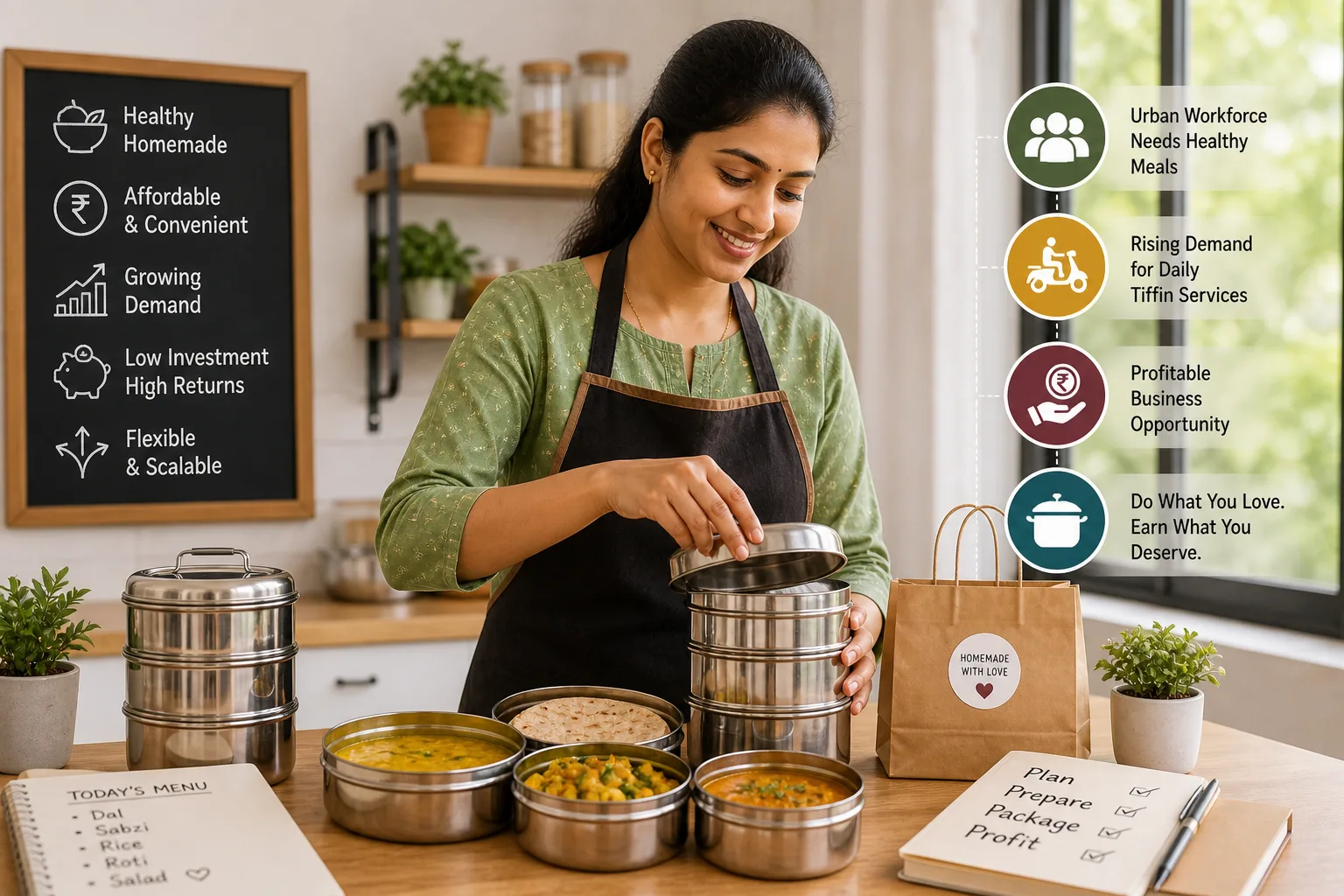
Ask anyone who has ever moved to a new city for work or college, and they'll tell you the same thing: nothing hits harder than missing home-cooked food. This universal ache is exactly what has fuelled the explosive rise of tiffin services across India — and what is now making smart food entrepreneurs very, very good money.
From solo home cooks in Pune delivering 30 boxes a day to organised tiffin startups in Bengaluru with fleet vehicles and app-based ordering, the tiffin economy has quietly grown into one of the most resilient segments of India's food industry. If you've been thinking about starting a food business with low investment and strong daily demand, this is your deep-dive into why tiffin services might be exactly what you're looking for.
The Demand Is Massive — and Growing
India has over 500 million working adults, a rapidly growing migrant workforce moving between cities, and millions of students living away from home in PGs and hostels. All of them need to eat — twice a day, every day — and most of them are deeply tired of restaurant food within a month of moving. This is the core demand pool that tiffin services tap into, and it's only growing as urbanisation accelerates.
The post-pandemic shift toward home-style, hygienic, and nutritious meals has made tiffin services even more appealing. Customers who became health-conscious during COVID have not gone back to oily, inconsistent restaurant meals as their daily staple. They want something that feels like ghar ka khaana — and they're willing to pay a fair price for it every single month.
What Makes the Tiffin Business Model Work
Unlike restaurants, tiffin services operate on a subscription model — and that changes everything. When a customer signs up for a monthly tiffin plan, you have predictable revenue before the month even begins. You know exactly how many boxes to prepare, how much raw material to buy, and how many delivery slots to fill. This predictability is what restaurants almost never have, and it is the single biggest reason tiffin businesses can stay profitable even at relatively small scale.
Other advantages that make this model attractive:
- Low wastage: You cook exactly what you need. There's no guessing on how many customers will walk in today.
- No dine-in overheads: No rent on a restaurant floor, no waiting staff, no air conditioning costs for a customer-facing space.
- Daily cash flow: Monthly subscriptions mean money comes in upfront, giving you working capital before you even cook a single meal.
- High retention: A customer who loves your food and trusts your hygiene will stay with you for months or even years without needing any marketing.
Revenue Potential: What Can You Actually Earn?
Let's look at real numbers. A typical home-based tiffin operator in a metro city charges between ₹150 to ₹250 per meal (lunch + dinner counted separately). If you serve 50 customers at ₹200 per meal, twice a day, that's ₹20,000 per day — or roughly ₹6 lakh per month in gross revenue. Even after raw material costs (typically 35–40% of revenue), packaging, and delivery, you're looking at a healthy margin that few other food business formats can match at this scale.
Data Insights
Estimated monthly gross revenue by tiffin service scale (based on ₹180 average per meal, 2 meals/day):
customers
customers
customers
customers
customers
*Gross revenue estimates. Net profit typically 40–55% after costs at home-kitchen scale.
How to Stand Out in a Crowded Market
The tiffin market in most Indian cities is fragmented — there are dozens of small operators in every neighbourhood. Winning in this space isn't about being the cheapest; it's about being the most trusted and consistent. Customers will pay a premium for tiffins that are always on time, always hygienic, and always taste like they were made with care.
A few strategies that successful tiffin operators use to build loyalty fast:
- Weekly rotating menus: Share your weekly menu on WhatsApp every Sunday. It makes customers feel valued and gives them something to look forward to.
- Customisation options: Offer Jain, diabetic-friendly, or high-protein variations. Even offering these at a small premium brings in customers who have felt excluded elsewhere.
- Referral rewards: Give existing customers a free meal or a week's discount for every new subscriber they bring. Word-of-mouth is your most powerful marketing tool in this space.
- Branded packaging: Even simple printed stickers on tiffin boxes with your name and WhatsApp number turn every delivery into a branding moment in shared kitchens and office pantries.
Taking It Online: The Next Level
Most home-based tiffin operators still rely on WhatsApp orders, which limits how fast they can grow. Once you're consistently serving 80–100 customers, consider listing on platforms like Swiggy Daily or building a simple Google Form-based subscription system. A Google My Business profile with genuine customer reviews can bring in a steady stream of new enquiries from people who just moved to your area and are searching for home food nearby.
The tiffin business is proof that in India, sometimes the simplest ideas — made with consistency and care — build the most durable businesses. Whether you're starting from your own kitchen or scaling an existing operation, the fundamentals remain the same: great food, on time, every day.
Want to explore more food business opportunities? Check out our latest coverage in the Food & Brands section.