
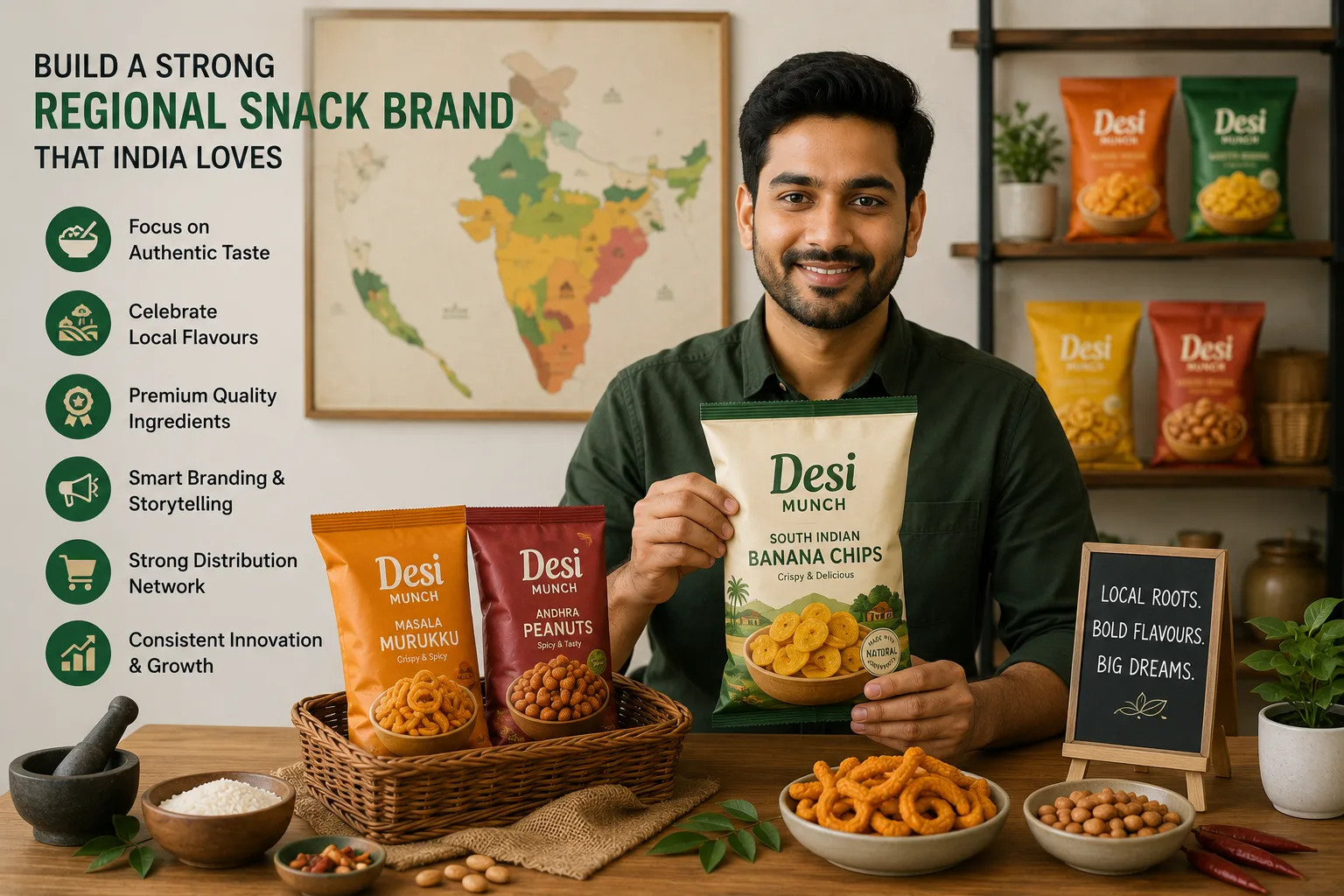
Walk into any kirana store in Maharashtra and you will find Haldiram's and Bingo prominently displayed. But look closer, and you will also find two or three local snack brands that are selling briskly — products that Haldiram's cannot replicate because they are rooted in local taste, local identity, and local distribution relationships that took years to build.
The regional snack opportunity in India is real, growing, and available to entrepreneurs who understand their market. This guide tells you exactly how to build one.
Why Regional Beats National in Snacks (If Done Right)
National snack brands are optimised for the average consumer. They cannot afford to cater to specific regional tastes — the spice levels, the texture preferences, the traditional flavours that differ dramatically between Rajasthan, Kerala, West Bengal, and Punjab.
Regional brands win on authenticity, freshness, and emotional connection. A murukku brand from Coimbatore carries different weight in Tamil Nadu than any national brand could manufacture. A chakli brand from Nashik that uses a 60-year-old family recipe has a story no marketing budget can fabricate.
Step 1: Define Your Regional Identity
Your first and most important decision is which regional identity you are building on. This should be:
- Geographically specific: Not "South Indian snacks" but "Tirunelveli-style sev" or "Vijayawada murukku"
- Authentically yours: A recipe, technique, or ingredient you genuinely have expertise in
- Commercially viable: There must be demand — start by validating locally before expanding
Brands that try to be "all of India" at launch fail to connect with anyone deeply. Start narrow, win that geography, then expand.
Step 2: Nail the Product Before the Brand
Packaging and branding can make a good product sell faster, but they cannot save a mediocre product. Before you invest in design, get brutally honest feedback from 20–30 people outside your family and friends. Farmer's markets, local exhibition stalls, and giving samples at relevant community gatherings are all ways to get genuine reactions.
Focus especially on:
- Shelf life: What is realistic without artificial preservatives? This determines your distribution radius.
- Consistency: Can you produce the same taste and texture batch after batch? Inconsistency is the number one reason small snack brands get returned by retailers.
- Packaging integrity: Does the packaging protect the product during 3–5 days of transit? Test this before committing to a distribution partner.
Step 3: Regulatory Foundation
Every packaged snack sold commercially in India requires FSSAI compliance. Beyond that, if your annual turnover exceeds ₹40 lakh, GST registration is mandatory. For snacks with health claims (multigrain, protein-rich, etc.), additional labelling and testing requirements apply.
Budget ₹15,000–₹30,000 for initial regulatory setup including FSSAI licence, label review, and basic lab testing for shelf life validation. This is not an optional expense.
Step 4: Pricing for Retail and D2C
Snack Brand Margin Structure
| Channel | Your Selling Price | MRP | Channel Margin |
|---|---|---|---|
| Direct (Instagram/Website) | = MRP (less shipping) | ₹150 | 0% (you keep all) |
| Modern Retail (supermarkets) | ~₹105 (70% of MRP) | ₹150 | 25–30% to retailer |
| Distributor → Kirana | ~₹90 (60% of MRP) | ₹150 | ~40% total channel cut |
| Amazon / Flipkart | ~₹112 (after fees) | ₹150 | 15–25% platform fee |
This is why D2C is so attractive for food brands — keeping 100% of the margin on direct sales funds investment in brand building and retail expansion later.
Step 5: Distribution Strategy
The most effective approach for a regional snack brand is a hub-and-spoke model:
- Own your home city first: Get listed in the top 20 local supermarkets, gourmet stores, and modern trade outlets in your city. This builds volume and brand recognition locally.
- Expand regionally: Use a distributor for your state. Interview at least three distributors and choose one who is genuinely excited about your product — unenthusiastic distributors will not push your brand.
- Use D2C for national reach: While your physical distribution is regional, your Instagram and website can sell nationally. Premium packaging and storytelling justify the higher price point for out-of-region customers.
Step 6: Building a Brand That Lasts
The snack brands that build lasting regional identities share a few characteristics: they have a memorable name that is rooted in the region or product, their packaging is distinctive even at small shelf sizes, they tell their story consistently across every channel, and they engage their community — participating in local food festivals, collaborating with regional food influencers, and building WhatsApp communities of loyal fans.
Case Study Snapshot: What Works
Several Indian regional snack brands that started in home kitchens between 2018 and 2021 have crossed ₹5 crore in annual revenue by 2026 — not by replicating national brands, but by doubling down on the very authenticity and regional specificity that national brands cannot offer. The pattern is consistent: strong product, compelling story, direct-first sales approach, and disciplined expansion.
Final Thoughts
You do not need a ₹5 crore production facility to build a ₹5 crore snack brand. You need a genuinely great product, a clear regional identity, regulatory compliance, and the discipline to execute consistently over 2–3 years. The regional snack opportunity in India is wide open for those willing to do the groundwork.
Discover more stories and strategies from Indian food entrepreneurs in our Food & Brands section on BusinessTalks.in.