
Starting a business does not always require a large office, a warehouse, or a heavy loan. In 2026, many of the most practical opportunities are service-led, digital-first, and built around skills that can be tested before serious money is spent. The real advantage is not simply choosing a trendy idea. It is finding a problem people already pay to solve, validating demand quickly, and building a repeatable way to deliver the solution.
For first-time founders, students, working professionals, and small-town entrepreneurs, a low-investment model can reduce pressure during the early months. It gives you room to learn how customers behave, which marketing channels work, and where margins are actually made. The goal should be to start lean, prove the business, and then invest more only when the numbers justify it.
What Makes a Low-Investment Business Worth Starting?
A good low-investment business has three qualities: low fixed costs, clear demand, and the ability to reach customers without expensive infrastructure. A business can still be difficult even when the starting cost is small, so founders should look beyond the initial budget. Time, sales ability, customer service, and consistency matter just as much as money.
Before choosing an idea, ask simple questions. Who is the customer? What problem are you solving? How often does the customer need the service? Can you charge enough to cover your time and operating expenses? Can one satisfied customer lead to referrals or repeat business? These questions help separate a real opportunity from an idea that only looks attractive on social media.
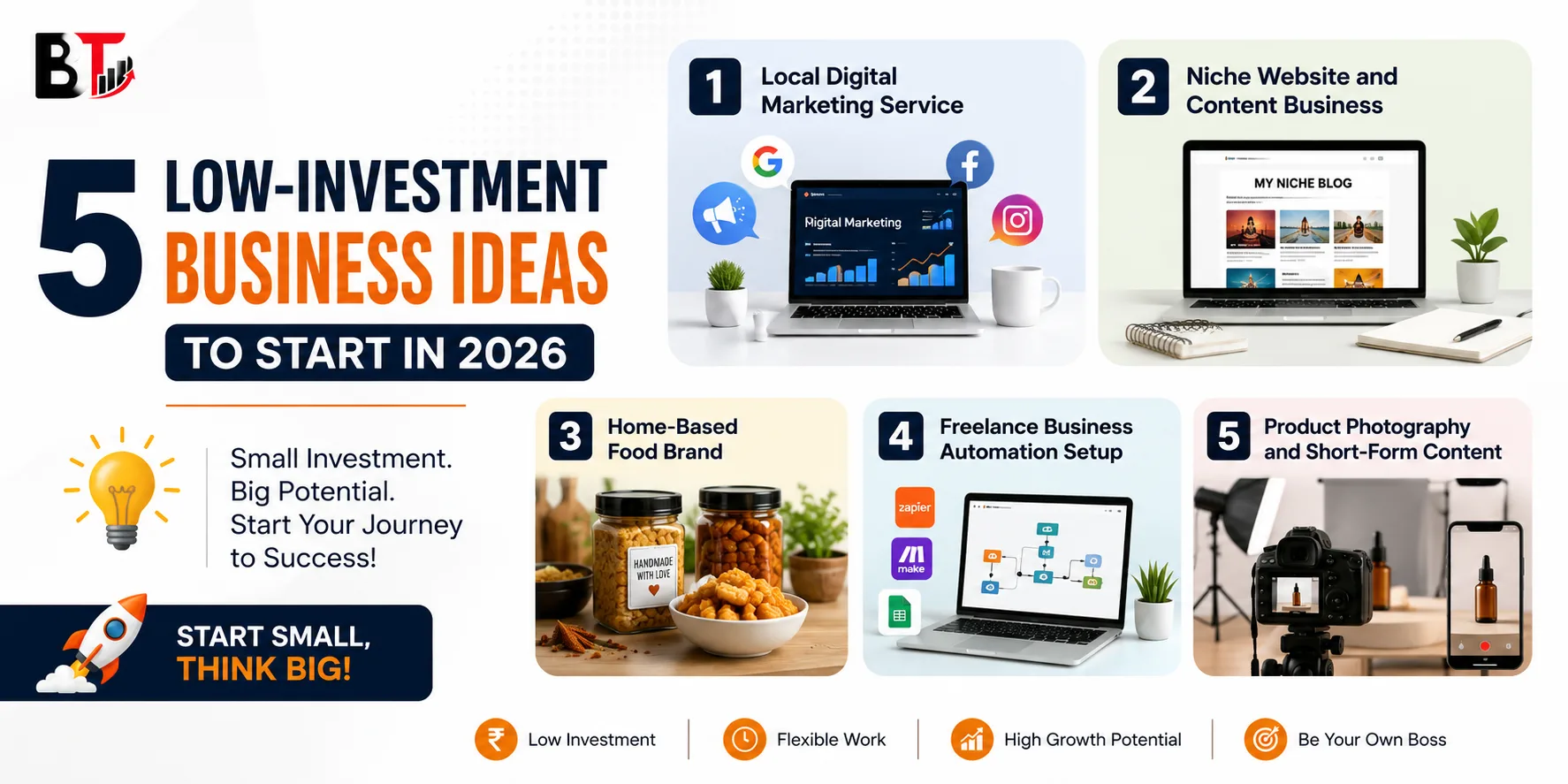
1. Local Digital Marketing Service
Many local clinics, gyms, restaurants, coaching centres, salons, repair shops, and professional service firms still struggle with basic online visibility. A small digital marketing service can help them manage Google Business Profile listings, social media posts, review responses, simple landing pages, local SEO, and lead follow-up systems.
You do not need to offer every marketing service from day one. Start with one clear package, such as local visibility management or monthly social content. Build two or three sample projects, create a simple presentation showing the expected work, and approach businesses directly. As results improve, you can expand into website development, paid campaigns, and content marketing. Business owners looking for deeper growth ideas can also explore our Marketing Insights section.
2. Niche Website and Content Business
A niche website can be built around a focused audience such as local business owners, career seekers, food enthusiasts, home buyers, software users, or a specific professional community. Revenue can come from advertising, sponsored features, affiliate partnerships, paid listings, and lead generation.
The biggest mistake is publishing random articles without a clear audience. A better approach is to choose a narrow theme, create useful search-driven content, and build authority over time. A site may take months to gain traffic, but the content can continue bringing visitors long after publication. This makes niche publishing slower than freelancing but potentially more scalable.
3. Home-Based Food Brand
A home-based food business can begin with a limited menu and a small delivery radius. Instead of offering twenty dishes, focus on one category that can be produced consistently: healthy lunch boxes, regional snacks, baked products, festive gift boxes, office meals, or premium homemade pickles.
Packaging, hygiene, repeatability, and delivery experience are critical. Start with pre-orders to reduce wastage. Use customer feedback to improve portion size and pricing. Once demand becomes stable, the brand can move toward a shared kitchen, cloud kitchen, retail counter, or corporate catering.
4. Freelance Business Automation Setup
Small businesses often waste time on manual follow-ups, spreadsheets, repetitive emails, appointment reminders, and lead tracking. If you understand tools such as spreadsheets, forms, CRM systems, email platforms, or simple web development, you can sell setup and automation services.
The value is easy to explain: save the owner time, reduce missed leads, and create a more organised process. A simple project may involve connecting a website enquiry form to a lead sheet, creating follow-up templates, or setting up automated reminders. As your experience grows, you can offer monthly support retainers.
5. Product Photography and Short-Form Content
Local brands need a constant supply of product photos, reels, catalogue images, and promotional creatives. A creator with a good smartphone, basic lighting, and editing skills can start with small assignments for cafes, boutiques, beauty brands, home businesses, and online sellers.
Clients care about consistency and business usefulness more than expensive equipment. Create a small portfolio, offer clearly priced packages, and show how the content can be reused across Instagram, WhatsApp catalogues, websites, and marketplace listings. Over time, this service can grow into a small content studio.
Startup Cost and Income Potential
| Business Idea | Typical Starting Cost | Revenue Model | Best For |
|---|---|---|---|
| Local digital marketing | ₹10,000–₹40,000 | Monthly retainers | Sales and marketing skills |
| Niche website | ₹5,000–₹25,000 | Ads, affiliates, promotions | Writers and SEO learners |
| Home food brand | ₹20,000–₹80,000 | Direct product sales | Food and operations skills |
| Automation setup | ₹5,000–₹30,000 | Project fees and support | Technical problem solvers |
| Product content service | ₹15,000–₹60,000 | Per shoot or monthly package | Creative professionals |
Note: These figures are practical planning ranges, not guaranteed costs or earnings. Actual requirements depend on your city, equipment, licences, marketing spend, and the level of service you provide.
How to Validate an Idea Before Spending Heavily
Validation does not require a long business plan. Create a basic offer and test whether real people are willing to pay. Speak with at least ten potential customers. Ask what they currently use, what frustrates them, how much the problem costs them, and what would make them switch.
Then build the smallest possible version of the business. A food founder can take pre-orders for one weekend. A marketer can offer a one-month pilot. A photographer can complete three portfolio shoots. A website publisher can produce twenty deeply useful articles before expanding into multiple categories.
- Start with one customer segment: Avoid trying to serve everyone.
- Keep fixed expenses low: Rent and unnecessary equipment can destroy early cash flow.
- Track every lead: Record where enquiries come from and which offers convert.
- Ask for referrals: A happy early customer can become your best marketing channel.
- Reinvest carefully: Spend more only on activities that improve sales, quality, or delivery.
Common Mistakes First-Time Founders Should Avoid
One common mistake is spending too much on branding before proving demand. A logo and website are useful, but neither can replace a strong offer. Another mistake is underpricing. Low prices may attract attention, but they can also leave no room for customer support, revisions, delivery costs, or future hiring.
Founders also need to separate revenue from profit. A business that collects ₹1 lakh in a month may still earn very little after expenses. Track gross margin, marketing cost, refunds, software subscriptions, delivery charges, and unpaid time. Simple financial discipline can prevent many early problems.
Conclusion: Start Small, Learn Fast, Build Around Demand
The best low-investment business is not necessarily the one with the lowest starting cost. It is the one that matches your skills, solves a real problem, and can reach paying customers without excessive risk. In 2026, digital tools make it easier to start lean, but competition also makes focus more important.
Choose one idea, define one customer group, and test one offer. Learn from actual conversations and transactions instead of waiting for perfect conditions. With disciplined execution, a small side project can become a dependable business, a specialised agency, a local brand, or a scalable digital asset. For more practical entrepreneurship ideas, explore Business & Income on BusinessTalks.in.