
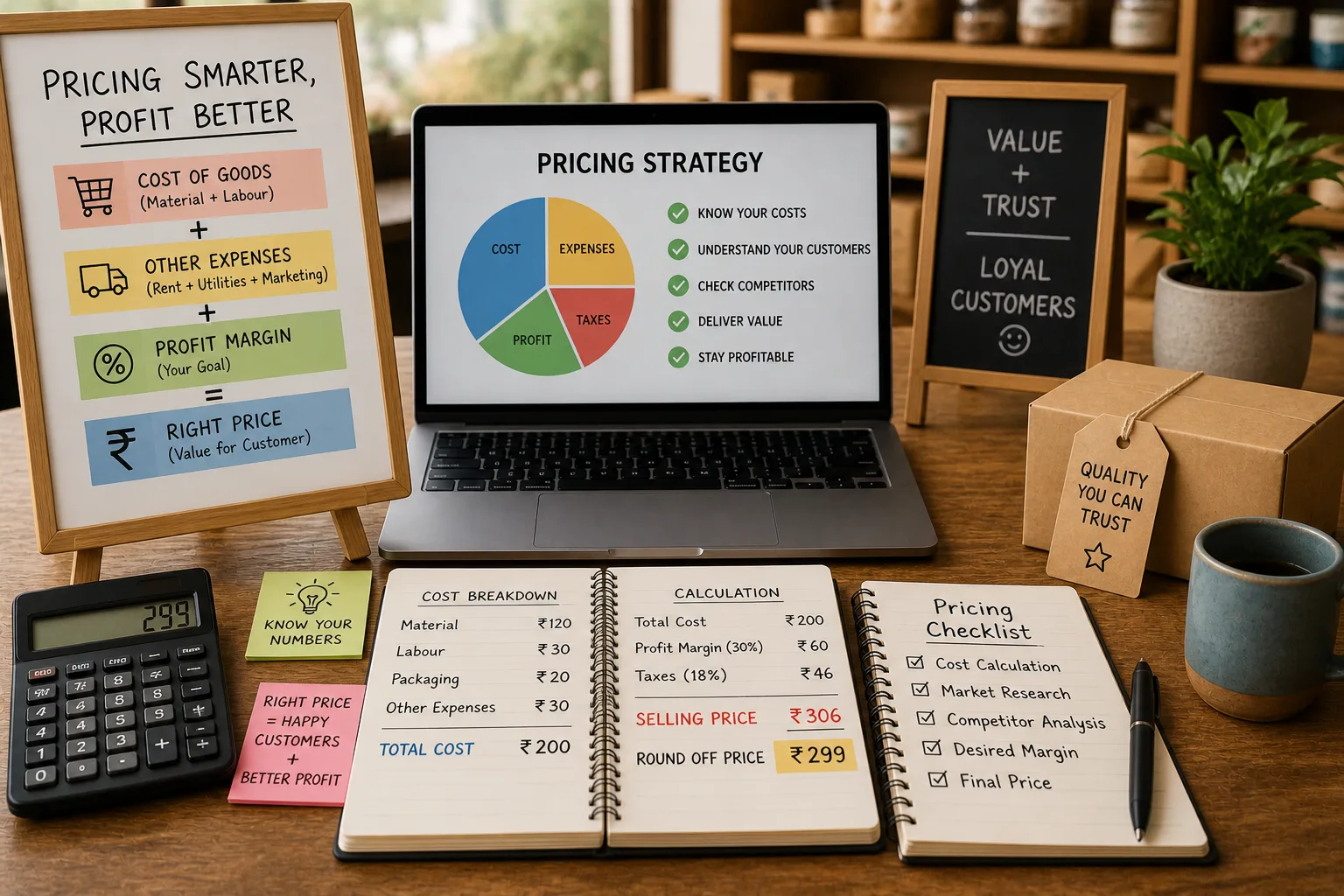
Pricing is one of the most powerful — and most misunderstood — decisions any business owner makes. Get it wrong, and you either scare away customers or bleed out slowly on thin margins. Get it right, and your business becomes sustainably profitable while customers feel they're getting genuine value. If you're running a small business in India, this guide is built specifically for the realities you face — competitive local markets, price-sensitive buyers, and a crowded online space.
Why Most Small Business Owners Underprice Their Products
The most common pricing mistake isn't overcharging — it's undercharging. Entrepreneurs in India often fall into the trap of pricing just slightly below competitors without doing the math on their actual costs. They forget to account for their own time, logistics, packaging, returns, taxes, and platform fees. The result? They hustle hard, sell a lot, and still struggle to pay themselves a salary.
Underpricing also signals low quality to buyers. Studies in consumer psychology consistently show that people associate price with value. A product priced too low can actually reduce trust, especially in categories like skincare, electronics accessories, or artisan food products.
Step 1: Calculate Your True Cost of Goods
Before you set a single price, you need to know your Cost of Goods Sold (COGS). This includes:
- Raw materials or wholesale purchase price
- Packaging and labelling costs
- Labour (including your own time, valued honestly)
- Shipping and logistics
- Storage or warehouse costs
- Platform fees (Meesho, Amazon, Shopify, etc.)
- Payment gateway charges (usually 1.5–3%)
Once you have this number, you have your floor. You cannot sustainably sell below this price — ever.
Step 2: Choose a Pricing Strategy That Fits Your Market
There is no single correct pricing model. Here are the most practical ones for Indian small businesses:
Cost-Plus Pricing
Add a fixed markup percentage on top of your COGS. For example, if a product costs you ₹200 to make and you want a 50% margin, you sell at ₹300. Simple, predictable, but doesn't account for what the market is willing to pay.
Value-Based Pricing
Price based on the value your product delivers, not just what it costs to make. A handmade silk saree might cost ₹800 in materials and labour but carry a ₹4,000 selling price because of craftsmanship, uniqueness, and heritage. This model works beautifully for artisan, niche, and premium products.
Competitive Pricing
Research what competitors charge and position yourself deliberately — slightly above (if you offer more value), at parity (if you're building volume), or below (only if you have a structural cost advantage). Don't go lower just out of fear.
Psychological Pricing
Pricing at ₹999 instead of ₹1,000 is a classic trick, but there's more to it. Bundling products, offering a "best value" tier in the middle of three options, and showing a crossed-out higher price can all influence purchase decisions meaningfully.
Step 3: Know Your Break-Even Point
Your break-even point is the number of units you need to sell to cover all your fixed costs (rent, salaries, subscriptions, etc.). Use this formula:
Break-Even Units = Fixed Costs ÷ (Selling Price – Variable Cost Per Unit)
If your fixed monthly costs are ₹30,000 and each product gives you ₹150 in contribution margin, you need to sell 200 units just to break even. Knowing this helps you set sales targets that are grounded in financial reality, not optimism.
Step 4: Factor In Market Positioning
Your price is a positioning statement. A budget product speaks to one audience; a premium product speaks to another. Before locking in a price, ask yourself: Who is my ideal customer, and what does my price say about my brand?
For brands targeting urban millennials on Instagram, a slightly higher price can reinforce aspirational value. For products targeting Tier 2 or Tier 3 city consumers, the right price point might be in a very specific range where affordability meets perceived quality.
Step 5: Test, Measure, and Adjust
Pricing is not a one-time decision. Run A/B tests on your product pages if you sell online. Offer limited-time pricing experiments. Track your conversion rates at different price points. Monitor competitor moves. As your brand grows, your pricing power grows too — don't be afraid to raise prices when you've built trust and reputation.
A Word on Discounting
Discounts can drive short-term sales, but chronic discounting destroys brand value. If you find yourself always needing a sale or coupon code to move inventory, the issue is usually either pricing (too high for the perceived value) or positioning (wrong audience). Fix the root cause rather than reaching for the discount lever every time.
Conclusion
Pricing your products correctly is both a science and an art. Start with solid numbers — know your costs down to the rupee. Then layer in strategy — where do you want to sit in the market, and why? Test, learn, and adjust over time. For more guidance on growing your business income smartly, explore our Business & Income resources on BusinessTalks.in.