
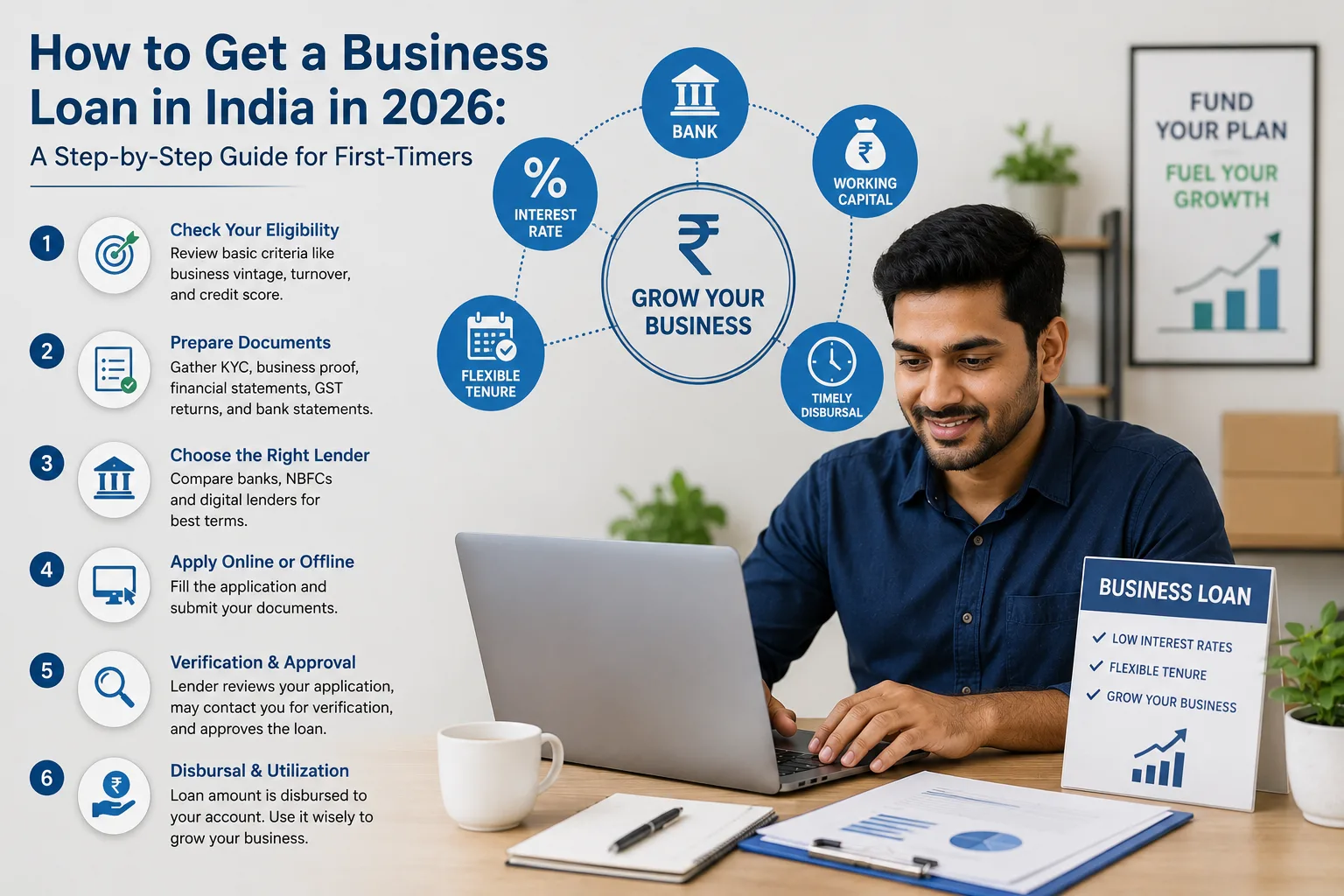
Access to capital remains one of the biggest barriers for small businesses in India. Too many good businesses stagnate — not because the market is not there, but because the owner does not know how to access funding or is intimidated by the process.
This guide walks you through every step of getting a business loan in India in 2026 — from understanding which type of loan you need, to what lenders actually look for, to the documents you need to prepare. No jargon, no fluff.
First: Understand What Type of Loan You Actually Need
Not all business loans are the same. Applying for the wrong type wastes time and can damage your credit profile if rejected. Here is a clear breakdown:
Business Loan Types in India
| Loan Type | Best For | Typical Amount | Typical Rate |
|---|---|---|---|
| Term Loan | Equipment, expansion, renovation | ₹5L – ₹2Cr | 10–18% p.a. |
| Working Capital Loan | Day-to-day operations, inventory | ₹1L – ₹50L | 12–24% p.a. |
| Overdraft / CC Limit | Flexible cash access against collateral | ₹5L – ₹1Cr | 9–14% p.a. |
| MUDRA Loan (Shishu) | Micro businesses, first-time borrowers | Up to ₹50,000 | 8–12% p.a. |
| MUDRA Loan (Kishor) | Growing small businesses | ₹50,000 – ₹5L | 8–14% p.a. |
| Invoice Financing | Businesses with large pending invoices | 70–90% of invoice | 1.5–3% per month |
| Government CGTMSE Loan | MSMEs without collateral | Up to ₹2Cr | 10–15% p.a. |
What Lenders Actually Look At
Whether you approach a bank, NBFC, or fintech lender, they are evaluating the same core factors:
1. Credit Score (CIBIL / Experian)
Your personal credit score matters significantly, especially for loans under ₹25 lakh. A score above 700 is the threshold for most lenders; above 750 gives you access to better rates. Check your score free on the CIBIL website or via apps like BankBazaar and PaisaBazaar before applying. If your score is below 650, spend 3–6 months improving it before applying for a loan — rejection will further damage your score.
2. Business Vintage
Most traditional lenders require a minimum of 2–3 years of business operation. If your business is newer than this, MUDRA loans, fintech lenders (FlexiLoans, Lendingkart, NeoGrowth), or CGTMSE-backed loans are more accessible options.
3. Revenue and Cash Flow
Lenders want to see that you can repay the loan from your business income. They will ask for 6–12 months of bank statements and ITR (income tax returns) for the last 2–3 years. Businesses with strong, consistent bank credits are significantly easier to finance than those with irregular deposits.
4. Collateral (for Secured Loans)
Secured loans (backed by property, FDs, or equipment) come with lower interest rates. Unsecured loans are faster but cost more. If you own property, pledging it as collateral can reduce your interest rate by 4–6% per annum — a significant saving on a large loan.
Documents You Need to Prepare
Gathering documents in advance speeds up approval significantly. Here is the standard checklist:
- PAN card (personal and business)
- Aadhaar card of all promoters
- Last 2–3 years of ITR with computation
- Last 6–12 months of bank statements (all accounts)
- GST registration certificate and last 6 months of GSTR-3B
- Business registration document (Udyam registration, GST, or company incorporation)
- Audited financials (for loans above ₹25 lakh)
- Collateral documents (if applying for a secured loan)
Where to Apply: Banks vs NBFCs vs Fintechs
Each lender type has distinct advantages:
- Public sector banks (SBI, Bank of Baroda): Lowest interest rates, especially for government-backed schemes. Slow processing (4–8 weeks), high documentation, branch-heavy process. Best for established businesses with clean financials.
- Private banks (HDFC, ICICI, Axis): Faster than public sector, competitive rates, relationship-based. Typically require 3+ years of banking relationship for best terms.
- NBFCs (Bajaj Finserv, Tata Capital): Faster approvals, more flexible underwriting. Rates slightly higher than banks but faster disbursement (5–10 days).
- Fintechs (Lendingkart, FlexiLoans, NeoGrowth): Completely digital, decisions in 24–72 hours, minimal paperwork. Higher interest rates (18–28%) but invaluable for businesses needing quick capital or with thin credit histories.
Common Mistakes First-Time Borrowers Make
- Applying to multiple lenders simultaneously — each application triggers a hard inquiry, dropping your CIBIL score
- Not checking eligibility before applying — use lender's online eligibility checkers first
- Borrowing more than you need — larger loans mean larger EMIs that can strain cash flow
- Ignoring processing fees and prepayment penalties — these can significantly change the effective cost
- Not having a repayment plan — know exactly which revenue stream will service the EMI
Government Schemes Worth Knowing in 2026
If you are an MSME, register on the Udyam portal if you have not already. Udyam registration unlocks access to priority sector lending, CGTMSE guarantee-backed loans (no collateral required), and various state government subsidy schemes for equipment and technology upgrades.
Disclaimer
Disclaimer: This article is provided for general informational and educational purposes only and should not be considered financial, legal, tax, or professional advice. Loan amounts, interest rates, eligibility requirements, processing times, government scheme limits, and lender policies may vary and can change over time. The figures mentioned in this guide are indicative and may not reflect the terms offered to every applicant.
BusinessTalks.in does not guarantee loan approval, interest rates, funding amounts, or processing timelines. Always verify the latest information directly with the relevant bank, NBFC, fintech lender, government portal, or qualified financial adviser before applying. Carefully review the loan agreement, annual percentage rate, processing fees, penalties, collateral requirements, and repayment obligations before accepting any financial product. Borrow only after assessing your business cash flow and repayment capacity.