
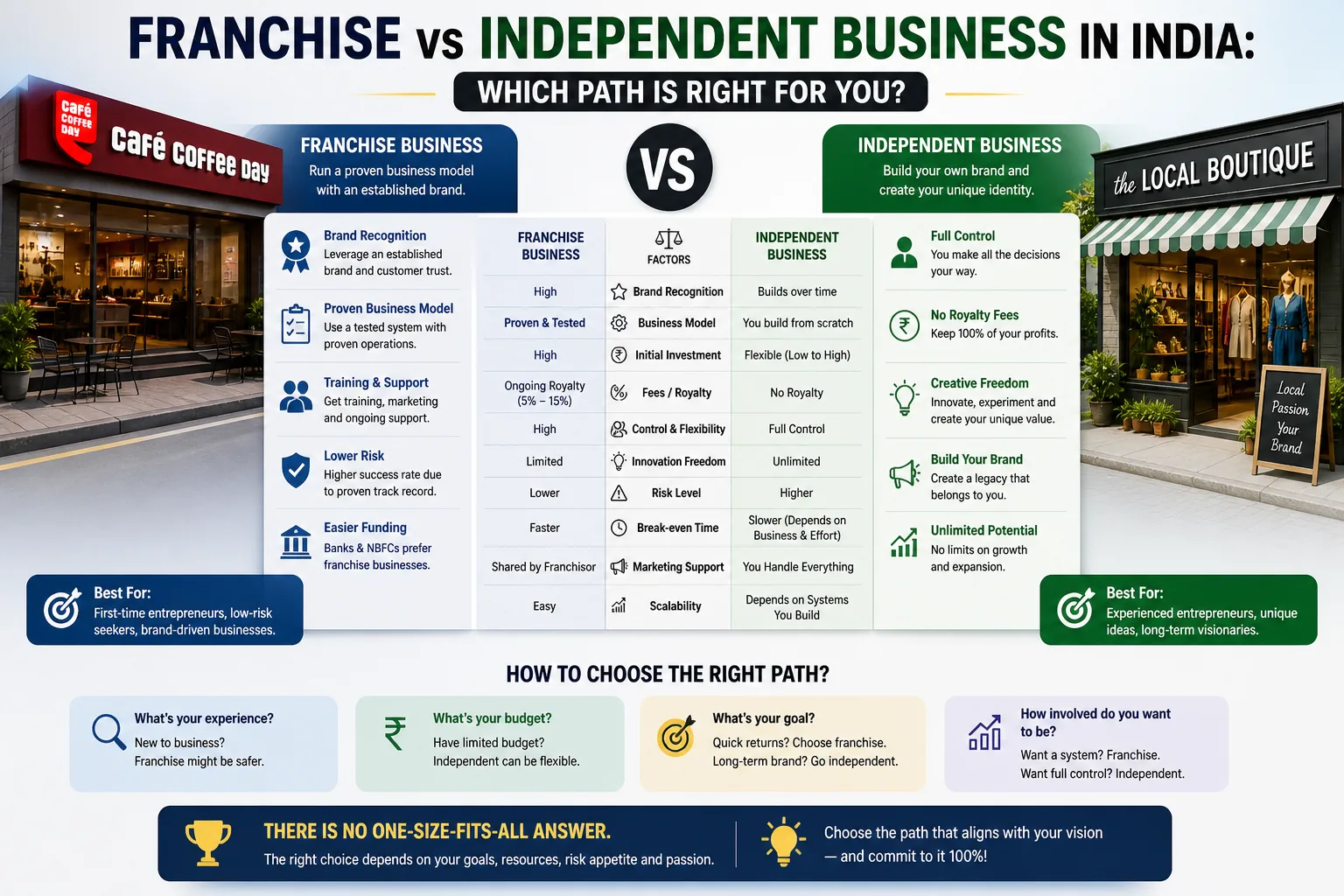
One of the most fundamental decisions anyone considering entrepreneurship in India faces is this: do you buy into a proven franchise system, or do you build something entirely your own? Both paths have produced extraordinary successes — and both have produced painful failures. The right answer depends almost entirely on who you are, what resources you have, and what you want your life as a business owner to look like.
This guide gives you an honest, clear-eyed comparison so you can make the decision that's actually right for your situation.
Understanding the Franchise Model
A franchise is essentially a licensed business system. You pay an upfront franchise fee and ongoing royalties in exchange for the right to operate under an established brand, use a proven business model, receive training and support, and benefit from existing customer recognition. Popular franchise categories in India include food and beverages (Subway, Domino's, Chai Sutta Bar), education (NIIT, Kidzee), retail (Jockey, Bata), and healthcare services.
The appeal is obvious: you're not starting from zero. The product is developed, the systems are documented, the brand has recognition, and you have a support network to call when things go wrong.
Understanding the Independent Business Model
An independent business is built from scratch — your idea, your brand, your systems, your risk. You have complete control over every decision, from the product you sell to the customers you target to the culture you build. There are no royalties to pay, no franchisor rules to follow, and no ceiling on how far you can take the brand.
The challenge, of course, is that you start with nothing but an idea. Building brand recognition, developing systems, and figuring out what works through trial and error takes time, money, and resilience.
Side-by-Side Comparison
| Factor | Franchise | Independent Business |
|---|---|---|
| Upfront Investment | High (₹5L – ₹1Cr+) | Variable (₹50K – ₹50L+) |
| Brand Recognition | ✅ Immediate | ❌ Must be built |
| Business Systems | ✅ Provided | ❌ Self-developed |
| Creative Control | ❌ Limited | ✅ Complete |
| Ongoing Royalties | Yes (4–12% of revenue) | None |
| Training & Support | ✅ Structured | Self-sourced |
| Scalability | Multiple units possible | ✅ Full potential |
| Risk Level | Moderate (proven model) | Higher (unproven) |
The Honest Case for Franchising
Franchising makes sense if you have capital but limited business-building experience, if you want a faster path to profitability, or if you simply want to run a business rather than build one. The structured support, established customer base, and brand recognition reduce the learning curve dramatically. In categories like QSR (quick service restaurants), education, and fitness, franchises have a demonstrably better success rate than independent startups.
That said, research your franchisor rigorously. Talk to existing franchisees — not just the ones the franchisor recommends. Understand the royalty structure fully. Read the Franchise Disclosure Document carefully, ideally with a lawyer.
The Honest Case for Going Independent
If you have a genuine insight into an underserved market, a unique product or service, and the resilience to survive the early years of uncertainty, building something independently can be far more financially rewarding in the long run. You keep 100% of the profits, you build an asset that belongs entirely to you, and you have the freedom to innovate and pivot as the market evolves.
Independent businesses also allow for more personal expression and mission alignment. If you care deeply about a specific community or cause, you can build your business around those values in a way a franchise system may not allow.
Questions to Ask Yourself
- Do I have the financial runway to survive 12–18 months without significant income?
- Am I comfortable making decisions without a proven playbook?
- Do I have a unique idea or insight, or am I drawn to execution?
- Is brand-building something I'm excited about or something that feels like a burden?
- What does my support network (family, mentors, partners) look like?
Conclusion
Neither path is inherently superior — both have created generational wealth for Indian entrepreneurs and both have produced costly failures. The right choice is the one that aligns with your skills, your capital, your risk tolerance, and your vision for your life. If you're a first-time entrepreneur with capital and a preference for proven systems, franchising offers a relatively safer entry point. If you're an experienced professional with a strong idea and appetite for the building process, go independent. For more guidance on business decisions, visit our Business & Income hub.