
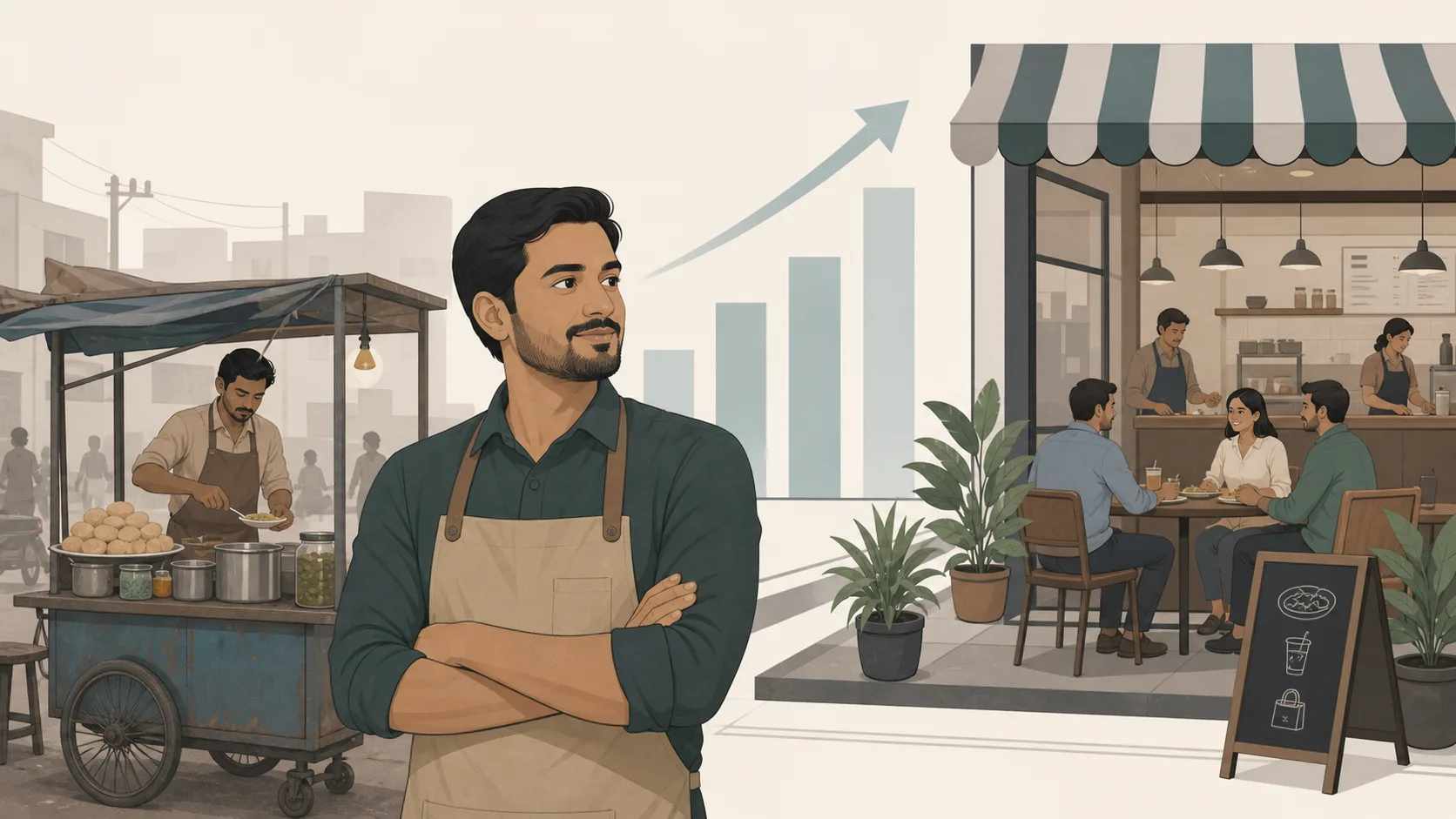
India has always had a rich street food culture. From the vada pav stalls of Mumbai to the chaat corners of Delhi's Chandni Chowk, local food vendors have fed millions of people daily for generations. But something has changed in the last decade. A growing number of these street-level food businesses are doing something that would have seemed impossible for their predecessors: they are scaling up, building brands, and crossing revenue milestones that were once the exclusive domain of organised restaurant chains.
This article is about those entrepreneurs — and more importantly, about what they did differently.
The Shift: From Selling Food to Building a Brand
The fundamental turning point for most of these businesses came when the owner stopped thinking of themselves as a food vendor and started thinking of themselves as a brand builder. That might sound abstract, but the practical implications are very concrete: consistent presentation, standardised recipes, a recognisable identity, and the deliberate effort to create a customer experience — not just a transaction.
Consider the story of a paani puri stall operator in Ahmedabad who began numbering his flavours and putting up a menu board with clear pricing. Within three months, his queue was longer than any competitor nearby, because customers could now tell friends exactly what to try. He had created a referral mechanism without spending anything on marketing.
Going Digital: The Role of Zomato, Swiggy, and Google
Online food delivery platforms have been transformational for ambitious street food operators. Getting listed on Zomato or Swiggy essentially gives a small kitchen the same distribution reach as an established restaurant chain. The barrier to entry is remarkably low — a PAN card, FSSAI registration, a bank account, and quality food photography are often enough to get started.
Smart operators use aggregator platforms not just as an order channel but as a review-building engine. Every satisfied delivery customer who leaves a five-star review is improving your ranking on the platform and building credibility with every potential new customer who sees your page. The platforms also provide data — most popular dishes, peak order times, repeat customer rates — that a paper-based street operation would never have access to.
The Packaging Revolution
Nothing signals a brand's seriousness to a customer quite like good packaging. When a local mithai shop starts delivering in branded boxes with a small card explaining their family recipe tradition, the perceived value of the product increases — even if the recipe hasn't changed at all. Several local food entrepreneurs have found that upgrading packaging alone, even modestly, allowed them to raise prices by 15–25% without losing customers.
Packaging also enables the gifting market, which is enormous in India. A local sweet brand that presents itself attractively can compete for Diwali and Eid gifting orders that would previously have gone to national brands by default.
Building a Social Media Presence That Actually Works
The most effective social media content for food businesses is almost absurdly simple: real food, good lighting, short videos. A 30-second reel showing biryani being plated, a crispy dosa being served, or a sweet being made by hand will consistently outperform professional studio photography in reach and engagement.
Several local food businesses in Tier 2 and Tier 3 cities have built Instagram followings in the tens of thousands purely through consistent, authentic short-form video content — which then drives offline footfall and online orders. The investment is essentially zero beyond a smartphone and a little time.
Franchising as a Growth Strategy
The final phase of scaling for many successful local food brands is franchising. Rather than investing capital in opening new company-owned locations — which is capital-intensive and operationally complex — they systemise their operation and find local operators willing to invest in running the model themselves.
Several regional food brands have grown from 1 to 20+ locations in just 3–4 years using franchise models. The key requirements are: a standardised, replicable system for food preparation; documented training processes; a supply chain that can serve multiple locations; and a brand identity strong enough that customers will travel to or seek out a franchise location.
What Every Local Food Entrepreneur Can Learn
- Consistency in quality and experience is the foundation of every scaling story
- Your story — where you come from, why you cook what you cook — is a competitive asset
- Digital platforms (Zomato, Swiggy, Instagram, Google) are available to everyone; using them well is a choice, not a cost
- Packaging communicates quality before a customer takes a single bite
- Systems enable scale — document your recipes, processes, and standards as if you're preparing to train someone else to run it
Conclusion
The gap between a street food stall and a crore-plus business is real, but it is not insurmountable. Across India, a new generation of food entrepreneurs is proving that great food, combined with smart branding, digital tools, and genuine hustle, can build something significant from very humble beginnings.
We regularly feature stories of local business owners who are doing exactly this. Read more inspiring profiles in our Local Businesses section on BusinessTalks.in.