
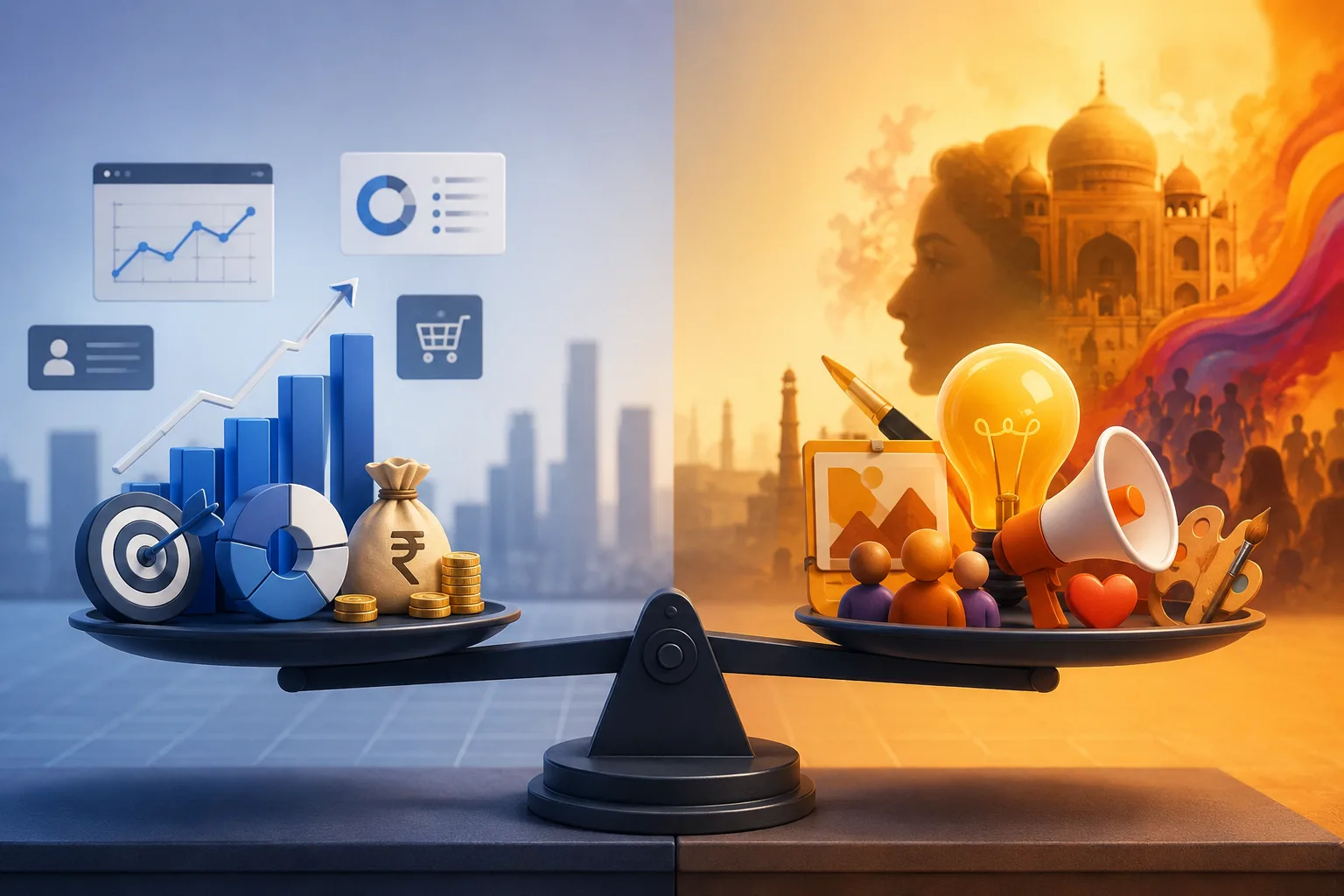
Every Indian business owner who has run ads has faced some version of this question: should I be building brand awareness, or should I be driving direct conversions? The performance versus brand marketing debate has been around for decades, but in 2026 — with rising ad costs, increasingly fragmented attention, and consumers more sceptical of advertising than ever — getting this balance right has become a genuine competitive edge.
The real answer, for almost every business, is that it's not a binary choice. The most successful Indian businesses run both — but at different stages, in different proportions, and toward different goals. Here's how to think about it clearly and practically.
What Performance Marketing Actually Is
Performance marketing refers to any paid marketing channel where you're paying based on a specific, measurable action — a click, a lead, an install, a purchase. Google Ads, Meta Ads, affiliate marketing, and influencer campaigns with tracked conversion links all live in this category.
The appeal is obvious and legitimate: you can see what you're getting for each rupee spent. Spend ₹10,000 on Meta Ads, generate ₹45,000 in sales, and your return on ad spend is 4.5x. Clean, measurable, directly tied to revenue. For a cash-strapped business trying to survive its first year, this visibility is genuinely important.
What Brand Marketing Actually Is
Brand marketing is about building recognition, trust, and emotional affinity over time. It includes activities that don't have an immediate, traceable conversion but create the conditions under which conversions happen more easily, more frequently, and at higher average values.
This covers content marketing, SEO-driven articles, organic social media, earned media coverage, podcast sponsorships, community building, and even the quality of your packaging and post-purchase experience. It's harder to attribute directly, but it's what makes customers choose you over a competitor even when the competitor is cheaper. That's the most durable competitive advantage in business.
Why Running Only Performance Marketing Is a Trap
A business that relies entirely on performance marketing is building on land it doesn't own. The risks are real and worth understanding before you optimise yourself into a corner:
- Ad costs keep rising. CPM and CPC rates on Meta and Google have increased significantly over the past three years across virtually every category. Businesses dependent entirely on paid traffic are in a continuous margin squeeze with no end in sight.
- Creative fatigue accelerates. When your entire acquisition strategy runs through paid ads, you're constantly churning out new creatives to fight fatigue. Your messaging never sinks deep enough into consumer memory to build lasting brand recall — so you have to keep paying forever to stay relevant.
- There is no defensible moat. A competitor with more capital can simply outspend you on the same channels tomorrow. If your only edge is paid distribution, you have no durable competitive position.
- Attribution is increasingly unreliable. Between iOS privacy changes, ad blockers, and genuinely multi-touchpoint customer journeys, the ROAS numbers in your dashboard are often overstated. Businesses that optimise purely for attributed performance frequently end up cutting their best brand-building channels because they can't see a direct return — and then wonder why their performance campaigns start requiring higher budgets to achieve the same results.
Why Brand-Only Doesn't Work Either
Unless you have the marketing budget of a Tata or a Hindustan Unilever, building purely through awareness-level brand activities without a performance engine is slow, expensive, and very difficult to sustain through the early years of a business. Most small and mid-size Indian businesses cannot afford to wait 18 months for brand-building investments to translate into measurable sales.
Brand marketing also requires consistency and meaningful reach to work. A few brand-focused social posts per week, or a one-off sponsored segment on a podcast, won't create the frequency of exposure needed for genuine brand recall in a crowded market. Scale and consistency are prerequisites — and both cost money.
The Framework That Actually Works: Funnel Alignment
The most practical approach is aligning your marketing investments to the stage of the buying journey you're addressing:
- Top of funnel — Awareness: This is where brand marketing belongs. Content, SEO articles, YouTube, organic social, PR. The goal is to introduce your brand to cold audiences at a cost-efficient scale. You're not trying to sell at this stage — you're trying to be known and trusted.
- Middle of funnel — Consideration: This is where retargeting, comparison content, email nurture sequences, and lead magnets come in. A blend of light performance activity and content-based nurturing works best here. You're moving warm prospects toward a decision.
- Bottom of funnel — Conversion: This is pure performance territory — conversion-optimised ads, time-sensitive offers, direct response messaging, abandoned cart recovery. This is where you spend to close.
For most growing Indian businesses in 2026, a reasonable starting allocation looks like: 30% toward brand and top-of-funnel content, 30% toward mid-funnel engagement and nurturing, and 40% toward conversion-focused performance campaigns. That ratio evolves as your brand equity grows. Established brands with strong recognition can lean more toward brand investment and see their performance efficiency improve as a result.
How to Actually Measure Brand Marketing
One reason brand marketing gets cut when things get tight is that it appears unmeasurable. It isn't — it's just measured differently. Track these indicators consistently:
- Direct website traffic and branded search volume month over month (are more people searching your brand name organically?)
- Organic share of voice in your category on social platforms
- Email open rates over a rolling 6-month period (a trusted brand gets opened; an unfamiliar one gets ignored)
- Net Promoter Score or simple customer satisfaction surveys quarterly
- Repeat purchase rate (loyalty is driven by brand, not just performance marketing)
A Simple Rule of Thumb by Business Stage
If your business is under 12 months old: lean approximately 70% toward performance and 30% toward brand. Generate cash flow and learn from real audience response what messaging actually works. Between one and three years with a proven product and stable retention: move closer to a 50/50 split and start building organic channels, community, and earned media seriously. Beyond three years with strong customer retention and repeat purchases: begin tilting meaningfully toward brand investment. Your performance campaigns will actually become more efficient as brand recognition rises.
The Bottom Line
Performance and brand marketing aren't rivals — they're different tools for different parts of the same journey. Businesses that understand this stop having the wrong argument and start building something that compounds over time. The brands dominating their categories in India five years from now are already investing in both, even imperfectly and on tight early budgets.
Explore more practical marketing guides in our Marketing Insights section. If you're looking for tools to execute both strategies more efficiently, our Products & Reviews section compares the best platforms for Indian businesses across every budget level.