
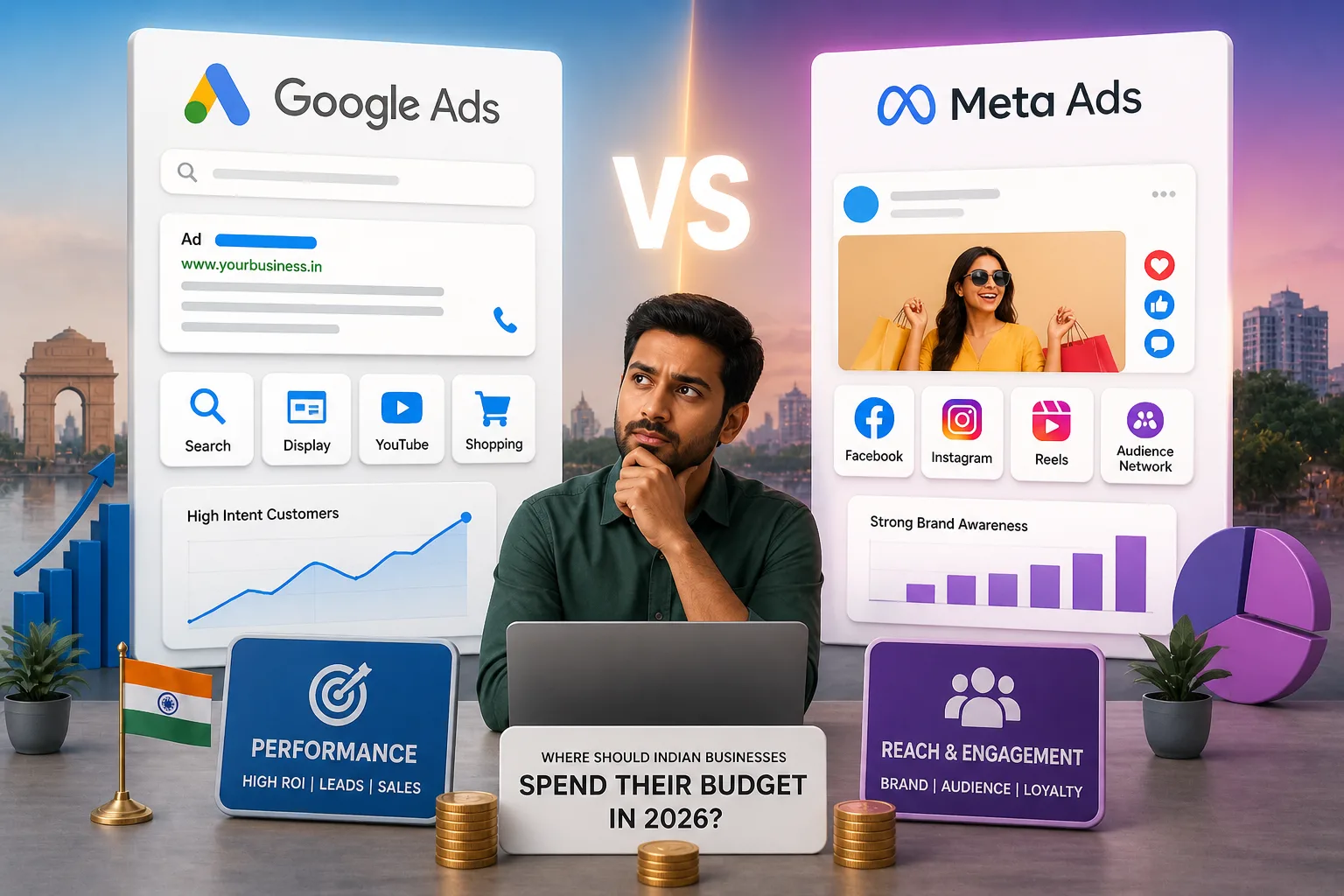
Every Indian business owner running digital ads eventually faces the same question: should the budget go into Google Ads or Meta Ads (Facebook and Instagram)? Both platforms are powerful. Both can deliver results. But they work very differently, and the right choice depends almost entirely on what your business sells and who your customer is.
In this guide, we break down the key differences, real-world performance data, and a practical framework to help you make the right decision for your business in 2026.
Understanding the Fundamental Difference
Before comparing budgets and costs, you need to understand one critical difference in how these platforms work:
Google Ads is intent-based advertising. Your ad appears when someone is actively searching for what you sell. If someone types "pest control service in Hyderabad," they have a need right now. You are meeting demand that already exists.
Meta Ads (Facebook and Instagram) is interest-based advertising. You are showing ads to people who fit a demographic or interest profile, but who are not necessarily looking to buy right now. You are creating demand rather than capturing it.
This single distinction explains almost everything else about how these platforms perform for different business types.
When Google Ads Wins
Google Ads tends to deliver stronger results when:
- Your product or service solves an urgent, specific problem (plumbing, legal services, medical care, loans)
- Customers actively search before buying (CA services, software tools, courses)
- You are targeting high-intent, ready-to-buy customers
- Your average transaction value is high enough to justify a higher Cost Per Click
In India, Google Search Ads for categories like insurance, education, real estate, and B2B services consistently deliver strong Return on Ad Spend (ROAS) because search intent is very high in these sectors.
When Meta Ads Win
Meta Ads tend to deliver stronger results when:
- Your product is visual — fashion, food, home decor, beauty, jewellery
- You are building brand awareness for a new product or business
- Your target audience is defined by demographics or lifestyle (young mothers, fitness enthusiasts, college students)
- You are retargeting people who have already visited your website or engaged with your brand
Indian D2C brands in fashion, skincare, and food have found extraordinary success on Instagram in particular, using Reels and Story ads to drive discovery and impulse purchases.
Cost Comparison in the Indian Market
Data Insights
Average Cost Per Click (CPC) — India Market 2026
Search
Shopping
Feed
Feed
Reels
* Approximate average CPC across industries. Actual costs vary by sector and audience targeting.
The Smartest Strategy: Use Both Together
The most successful Indian digital advertisers in 2026 are not choosing between Google and Meta — they are using both in a coordinated funnel strategy.
Here is a practical model that works well for mid-sized Indian brands:
- Top of Funnel: Use Meta Ads (Instagram Reels and Facebook) to build awareness and drive traffic. Costs are lower, reach is massive.
- Middle of Funnel: Retarget website visitors and video viewers with Meta Ads offering social proof and testimonials.
- Bottom of Funnel: Use Google Search Ads to capture people who are now actively searching for your brand or product category. Close the sale here.
This approach maximises the strength of each platform and significantly lowers your overall Customer Acquisition Cost compared to relying on a single channel.
How to Decide If You Have a Small Budget
If you have under ₹15,000 per month to spend on ads, focus on one platform first. As a general rule: if people search for what you sell (lawyer, pest control, web designer), start with Google. If people need to discover what you sell (a new skincare brand, a niche food product, a clothing line), start with Meta.
Conclusion
There is no universal winner in the Google Ads vs Meta Ads debate. The right answer depends on your product, your customer, and your goals. What is certain is that both platforms offer enormous opportunity for Indian businesses that invest the time to understand them properly.
For a deeper dive into digital advertising strategies, explore our Marketing Insights section. And if you are looking for tools to manage your campaigns more efficiently, check out our Products & Reviews guides.