
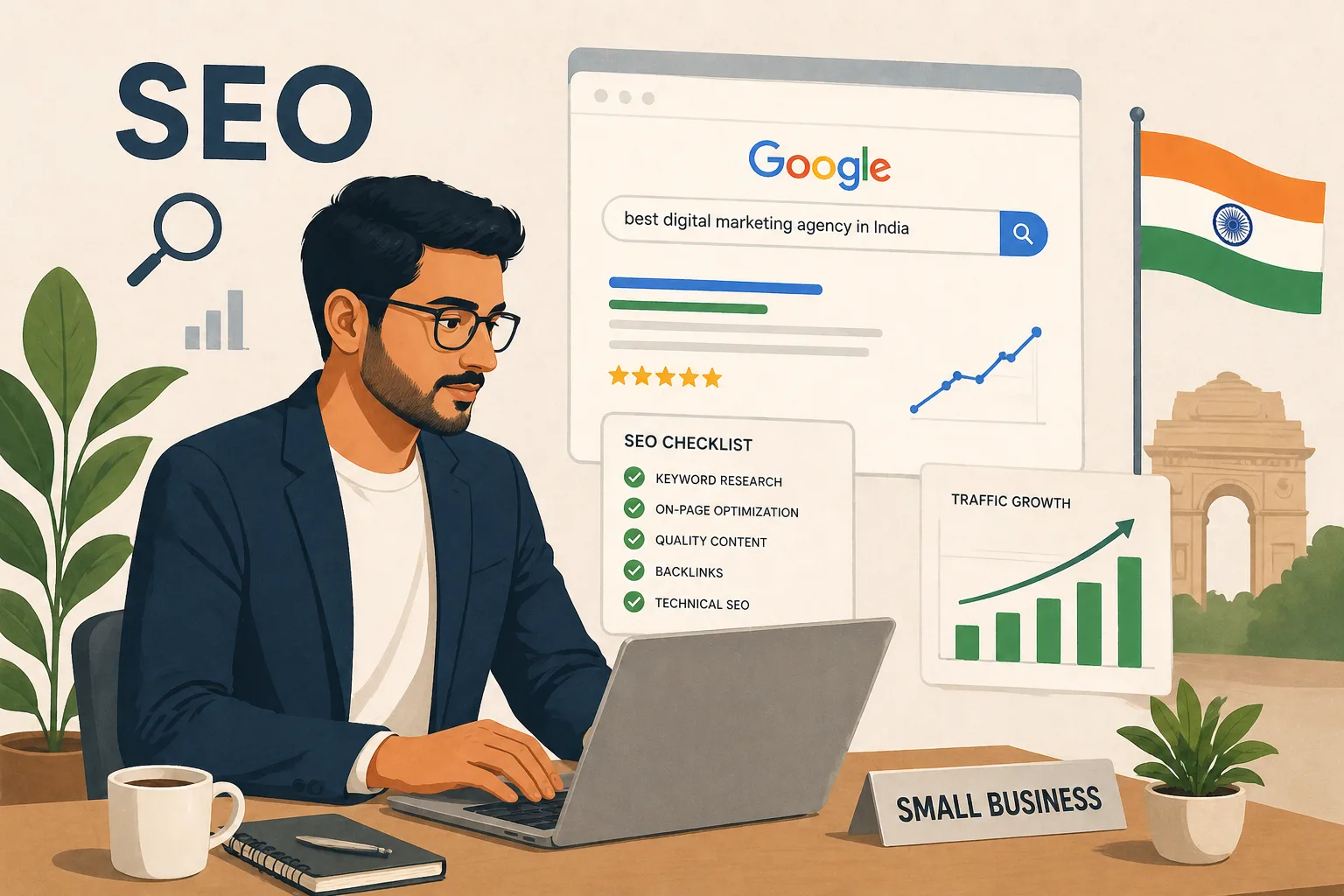
Search Engine Optimisation (SEO) has a reputation for being technical, expensive, and mysterious. That reputation is largely undeserved — at least at the level that matters most for small businesses. The fundamentals of SEO are knowable, learnable, and actionable without a specialist background or a large budget.
This guide gives you exactly that: a clear, jargon-minimal introduction to SEO specifically aimed at small business owners in India who want to show up when potential customers are searching for what they offer.
Why SEO Matters More Than Ever for Indian Small Businesses
Over 600 million Indians now use the internet, and the majority use it primarily on smartphones. When someone needs a product or service, their first instinct is almost universally to search Google. If your business does not appear in those search results — particularly for local and relevant queries — you are missing a massive stream of potential customers who are actively looking for you.
Paid advertising can buy your way into search results immediately, but SEO earns you presence that compounds over time and costs a fraction of paid traffic in the long run.
Understanding How Google Works (Simplified)
Google's job is to show the most relevant and trustworthy results for any given search query. It evaluates pages using hundreds of signals, but the most important factors boil down to three things:
- Relevance: Does your page clearly cover the topic someone is searching for?
- Authority: Does Google trust your website? Are other credible websites linking to yours?
- Experience: Is your website fast, mobile-friendly, and easy to navigate?
Your SEO strategy is essentially a plan for improving on all three dimensions over time.
Keyword Research: Start Here
Keywords are the phrases people type into Google when they're looking for something. Your goal is to identify the keywords your potential customers are using and create content that satisfies their intent better than any competing page.
Free tools for keyword research include Google Search Console, Google Keyword Planner, and Ubersuggest. Start by listing every question or problem your ideal customer might search for. Then look up how many people search those terms monthly, and how competitive the ranking is. Target a mix of high-volume terms (harder to rank for) and long-tail phrases (lower volume, but often higher intent and much easier to rank for quickly).
On-Page SEO Basics
On-page SEO refers to optimisations you make directly on your website pages. The essentials:
- Title Tag: Each page should have a unique title (under 60 characters) that includes your target keyword naturally
- Meta Description: A 150–160 character summary that appears in search results — write it to encourage clicks
- Headings: Use H1 for your main heading (one per page), H2s for major sections
- URL Structure: Keep URLs short, descriptive, and lowercase with hyphens (e.g. /seo-guide-small-businesses)
- Content Quality: Write thorough, accurate, genuinely helpful content — not thin filler designed just to include keywords
- Images: Compress for speed and add descriptive alt text
Local SEO: The Most Important SEO for Most Small Businesses
If your business serves a specific geographic area, local SEO is your highest-priority channel. The steps:
- Claim and fully complete your Google Business Profile
- Ensure your Name, Address, and Phone number (NAP) are consistent across all online directories
- Build a steady stream of genuine Google reviews
- Create local content — blog posts about local events, neighbourhood guides, local customer stories
- Get listed on Indian business directories like Justdial, Sulekha, IndiaMart where relevant
Technical SEO Fundamentals
Technical SEO ensures that Google can properly find, crawl, and index your website. The basics every small business site should have: HTTPS (SSL certificate), fast loading speed (aim for under 3 seconds), mobile-friendly responsive design, a sitemap submitted to Google Search Console, and no broken links. These are non-negotiable table stakes in 2024.
Link Building: The Slow but High-Value Work
Links from other websites to yours signal to Google that your content is trusted and worth referencing. For local businesses, start with the obvious: get listed on legitimate business directories, ask partners or local organisations to link to you, write guest articles for local publications or industry websites, and ensure your business is mentioned (with a link) in any press coverage or collaborations.
Measuring Your SEO Progress
Set up Google Search Console and Google Analytics if you haven't already — both are free. In Search Console, monitor which queries are driving impressions and clicks to your site, which pages are ranking, and any technical issues Google has flagged. In Analytics, track how organic search traffic behaves on your site: what pages they visit, how long they stay, and whether they convert.
SEO results compound over time. Expect the first three months to feel slow. By months six to twelve, well-executed SEO efforts typically become measurably visible in rankings and traffic.
Conclusion
SEO is not magic, and it is not instant. But it is one of the most reliable long-term investments a small business can make in its digital presence. Start with the fundamentals covered in this guide, be consistent, and build from there.
Explore our full range of digital growth resources in the Marketing Insights section on BusinessTalks.in — new guides published weekly.