
Budget wireless earbuds are no longer judged only by whether they play music. Buyers now expect clear calling, reliable battery life, comfortable fit, stable connectivity, usable controls, and charging cases that can survive everyday travel. The challenge is that product pages often highlight large numbers without explaining how the earbuds will feel in real use.
A smart buying decision starts with your main use case. Someone taking office calls has different priorities from a commuter listening to podcasts, a student attending online classes, or a casual gamer. Instead of chasing the longest feature list, compare the few features that affect your daily routine.
Start With Your Primary Use Case
Before comparing specifications, decide where you will use the earbuds most often. For calls, microphone quality and environmental noise handling matter. For workouts, fit and sweat resistance matter. For long listening sessions, comfort can be more important than powerful bass. For travel, battery life and a compact charging case become valuable.
Many budget earbuds try to appeal to everyone, but compromises are normal. A model tuned for heavy bass may not have the clearest voice reproduction. A very small earbud may feel comfortable but provide shorter battery life. Understanding your priority helps you accept the right compromise instead of paying for features you rarely use.
Call Quality: Look Beyond the Number of Microphones
Brands often advertise dual, quad, or multiple microphones, but microphone count alone does not guarantee clear calls. Software processing, microphone placement, wind handling, Bluetooth stability, and the shape of the earbud all influence voice quality.
For frequent calls, look for independent reviews that test the earbuds in quiet rooms, traffic, fans, and outdoor environments. A microphone can sound excellent in silence and struggle when background noise appears. Also check whether the voice becomes unnaturally compressed when noise reduction is active.
Battery Life: Separate Earbud Time From Case Time
Battery claims can be confusing because brands may combine the earbuds and charging case into one large total. The number that matters during a long meeting or journey is the continuous playback time of the earbuds themselves. The case extends total usage by recharging them between sessions.
Real battery life can be lower than advertised when volume is high, low-latency mode is active, or advanced features are enabled. A practical buyer should treat the published number as a best-case reference rather than a guarantee. Fast charging can be more useful than a very large total if ten or fifteen minutes of charging provides enough power for the next session.
Comfort and Fit Can Decide Whether You Keep Using Them
Sound quality means little if the earbuds hurt after thirty minutes. Ear shape varies, so comfort is personal. In-ear models with silicone tips usually provide a stronger seal and better bass, while semi-in-ear designs may feel lighter for some users but can allow more outside sound.
Check whether multiple ear tip sizes are included. A poor seal can reduce bass and make the earbuds feel unstable. For exercise, the shape should remain secure when walking or moving quickly. For work, lighter weight and lower pressure may matter more than maximum isolation.
Buyer Priority Comparison
| User Type | Top Priority | Second Priority | Feature to Verify |
|---|---|---|---|
| Office calls | Microphone quality | Comfort | Background-noise call tests |
| Commuting | Battery life | Secure fit | Case size and charging speed |
| Workouts | Fit | Sweat resistance | IP rating and stability |
| Entertainment | Sound tuning | Low latency | Video and gaming sync |
Sound Quality: Do Not Judge by Driver Size Alone
A larger driver can influence sound, but it does not automatically make one earbud better. Tuning, enclosure design, seal, codec support, and digital processing matter. Some budget models emphasise bass because it creates an immediate impression, while others aim for clearer vocals and a more balanced sound.
Think about what you listen to. Podcast and audiobook listeners may prefer clear mids and voices. Electronic and workout playlists may benefit from energetic bass. Movie watchers may value dialogue clarity and a wider presentation. Equaliser support in a companion app can be useful because it allows some adjustment without replacing the earbuds.
Noise Cancellation and Transparency Modes
Active noise cancellation can reduce steady sounds such as fans, air-conditioning, and some vehicle noise, but performance varies significantly. Budget ANC should be treated as a helpful reduction tool, not complete silence. The quality of the ear tip seal can also make a major difference.
Transparency or ambient mode lets outside sound pass through the microphones. This can be useful when walking, speaking with someone, or listening for announcements. A poor transparency mode may sound artificial or amplify wind, so usability matters more than simply having the feature listed.
Connectivity and Controls
Modern earbuds should reconnect reliably after the case is opened, but real-world stability still matters. Check for reports of one earbud disconnecting, audio cutting out in crowded areas, or delayed switching between devices. Multipoint connectivity can be valuable for users who move between a laptop and phone, though it is not essential for everyone.
Touch controls should be easy to remember and difficult to trigger accidentally. Useful controls include play and pause, track navigation, call handling, voice assistant access, and switching sound modes. Volume control on the earbuds can be convenient, especially during commuting.
Best Wireless Earbuds to Buy in 2026
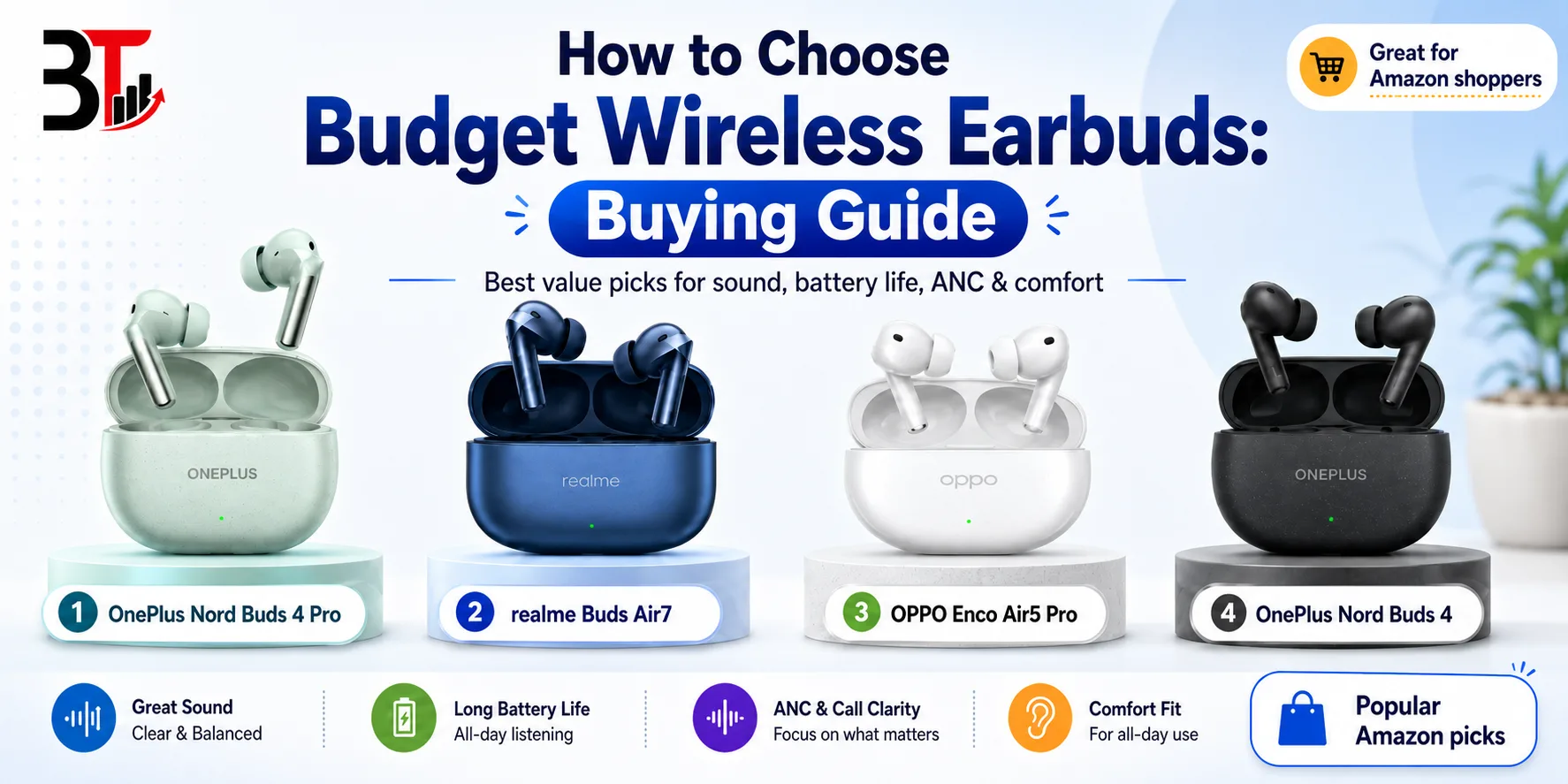
The best wireless earbuds in 2026 depend on your budget and priorities. Some buyers want the strongest active noise cancellation, while others care more about battery life, clear calls, sound quality, or overall value. The following models are among the most practical options to compare before buying.
Price Note: Prices mentioned in this article were recorded on 15 July 2025 and may change in the future due to discounts, sales, availability, or seller updates.
1. OnePlus Nord Buds 4 Pro – Best Overall Value
The OnePlus Nord Buds 4 Pro are one of the strongest all-round options for buyers who want premium-style features without paying flagship prices. They offer active noise cancellation, AI-powered calling features, powerful drivers, modern connectivity, and long battery life.
These earbuds are a strong choice for commuters, office users, students, and general listeners who want a balance of sound, calling, ANC, battery life, and modern connectivity. They are especially attractive for buyers who already use a OnePlus smartphone, although they can also work with other compatible devices.
Price: ₹3,999
Buy OnePlus Nord Buds 4 Pro on Amazon – ₹3,999
2. realme Buds Air7 – Best Budget ANC Choice
The realme Buds Air7 are a strong value-focused option for buyers who want active noise cancellation without spending heavily. They combine ANC, long battery life, powerful drivers, and useful connectivity features at a competitive price.
They are particularly suitable for students, daily commuters, and buyers who want a long feature list at a relatively affordable price. The combination of ANC, battery life, and sound features makes them one of the models worth comparing in the budget segment.
Price: ₹3,000
Buy realme Buds Air7 on Flipkart – ₹3,000
3. OPPO Enco Air5 Pro – Best for Calls and Commuting
The OPPO Enco Air5 Pro are designed for users who regularly listen or take calls in noisy environments. Their feature set focuses on active noise cancellation, clear calling, modern Bluetooth connectivity, and long battery life.
These features make the Enco Air5 Pro a particularly attractive option for office users, commuters, and frequent callers. Buyers who value voice clarity and noise reduction may prefer them over earbuds focused mainly on heavy bass.
Price: ₹4,999
Buy OPPO Enco Air5 Pro on Amazon – ₹4,999
4. OnePlus Nord Buds 4 – Best Balanced Mid-Range Alternative
The OnePlus Nord Buds 4 are another practical option for buyers who want modern features while spending less than the Pro model. They offer active noise cancellation, AI-assisted calling features, powerful drivers, and a lightweight design.
They are suitable for everyday music, calls, travel, and general entertainment. Buyers who do not need every feature of the Nord Buds 4 Pro may find the standard Nord Buds 4 a better value depending on their budget and requirements.
Price: ₹3,299
Buy OnePlus Nord Buds 4 on Amazon – ₹3,299
Best Earbuds by Use Case
| Category | Recommended Model | Price | Best For |
|---|---|---|---|
| Best overall | OnePlus Nord Buds 4 Pro | ₹3,999 | Balanced ANC, calls, battery, and sound |
| Best budget ANC | realme Buds Air7 | ₹3,000 | Maximum features at a lower price |
| Best for calls | OPPO Enco Air5 Pro | ₹4,999 | Office calls and noisy commuting |
| Best balanced alternative | OnePlus Nord Buds 4 | ₹3,299 | Everyday music, calls, and travel |
Affiliate Disclosure: Some of the links in this article may be affiliate links. If you make a purchase through these links, we may earn a small commission at no additional cost to you.
Do Not Overpay for Features You Will Not Use
Budget product marketing often focuses on long specification lists. Ask whether each feature improves your routine. RGB lighting, extremely low claimed latency, oversized battery totals, or special sound modes may look impressive but offer little value to some users.
Prioritise the basics: dependable connection, comfortable fit, acceptable microphone quality, sound you enjoy, and a warranty process you can actually use. A simpler product that performs consistently can be a better purchase than a feature-heavy model with unreliable software.
A Practical Pre-Purchase Checklist
- Calls: Check microphone samples in noisy environments.
- Battery: Compare continuous earbud playback, not only total case time.
- Fit: Confirm ear tip options and return policy where available.
- Charging: Check connector type and fast-charge support.
- Durability: Look for an appropriate water or sweat resistance rating.
- App support: Decide whether EQ, updates, and control customisation matter to you.
- Warranty: Review service availability and claim terms before purchase.
How to Compare Value Across Price Bands
At the lowest end of the market, focus on reliable audio and calling rather than premium extras. As the budget increases, improvements may appear in microphone processing, app support, build quality, ANC, multipoint connectivity, and sound tuning. The best value point is where the features you actually use become dependable.
A product is not automatically better because it costs more. Compare two or three options using the same priorities. Give each feature a simple score based on your use case. For example, an office user might give call quality 40 percent of the decision, comfort 25 percent, battery 20 percent, and sound 15 percent. A music-focused buyer could use a completely different weighting.
Conclusion
The best budget wireless earbuds are the ones that fit your daily habits, not the ones with the longest specification sheet. Start with your main use case, then compare call quality, battery life, comfort, sound, connectivity, and warranty in that order of personal importance.
For buyers comparing some of the best wireless earbuds to buy in 2026, the OnePlus Nord Buds 4 Pro offer a strong overall package at ₹3,999, the realme Buds Air7 focus on budget value at around ₹3,000, the OPPO Enco Air5 Pro are attractive for calls and commuting at ₹4,999, and the OnePlus Nord Buds 4 provide a balanced alternative at ₹3,299.
Prices and availability can change over time, so always check the latest selling price before making a purchase. Read real usage tests, pay attention to compromises, and avoid choosing only by one headline feature. A careful comparison can help you find a product that feels reliable after months of use rather than exciting only on the first day. For more practical buying guides and comparisons, visit Products & Reviews on BusinessTalks.in.