
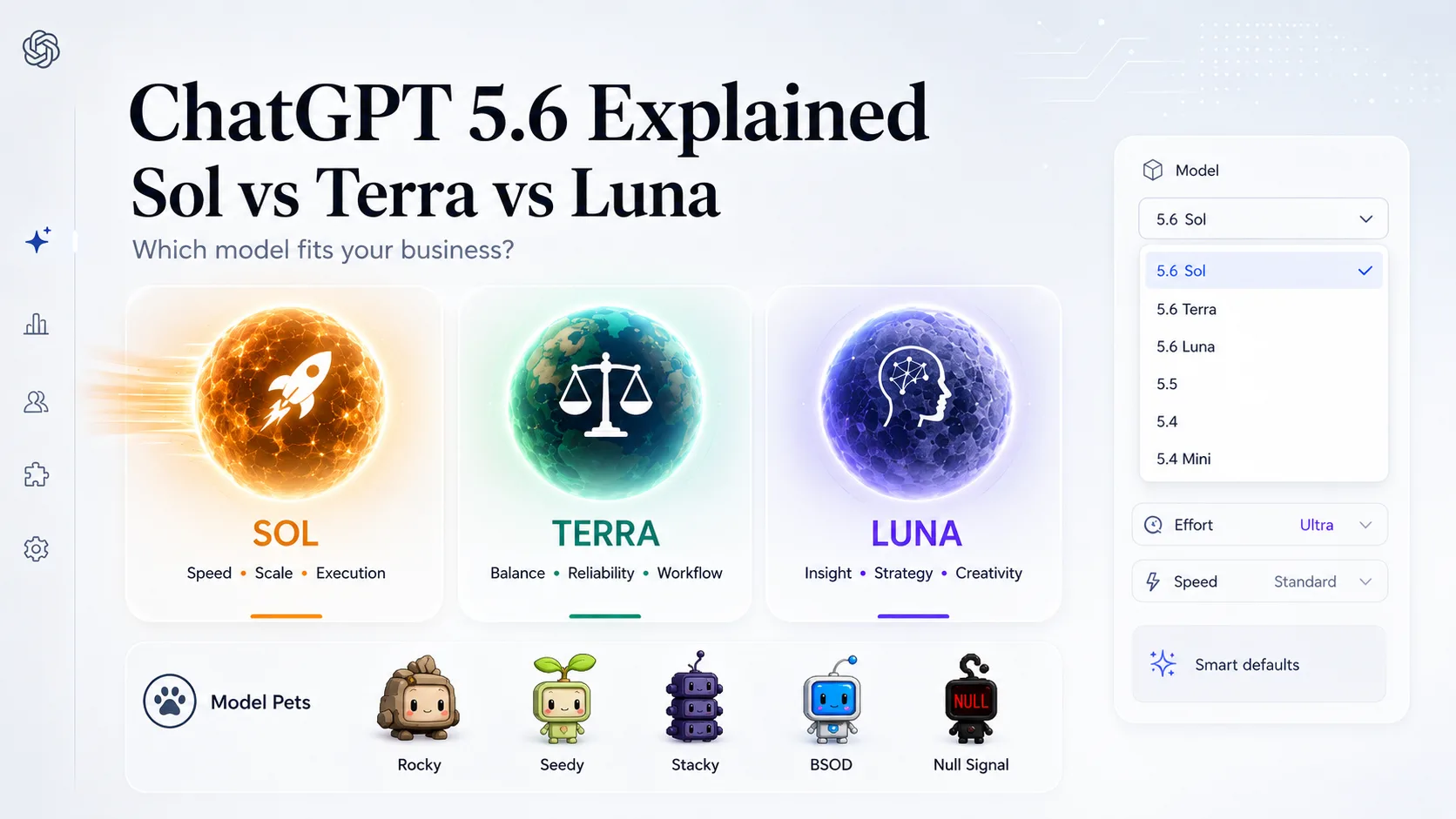
OpenAI has rolled out a new generation of ChatGPT called GPT-5.6, and for the first time it does not ship as a single model. Instead, it arrives as a family of three distinct tiers: Sol, Terra, and Luna. If your business already leans on ChatGPT for anything from drafting customer emails to researching competitors, this change affects how you should be choosing a model for each job. This guide breaks down what each tier actually does, roughly what it costs to run, and which one makes sense for the kind of work most small and mid-sized businesses handle every day.
What Is GPT-5.6?
GPT-5.6 became generally available on July 9, 2026, across ChatGPT, the Codex developer tool, and the OpenAI API. It replaces the old habit of picking one flagship model for everything and instead gives people three separate options built for different jobs. The thinking behind the split is straightforward: not every task needs the most powerful, most expensive model running at full strength. A quick summary of a support ticket does not require the same horsepower as untangling a complex pricing strategy, so OpenAI now lets users match the model to the task rather than paying flagship prices for every single request.
Meet the Family: Sol, Terra, and Luna
The naming approach is also a departure from the older "Pro" and "Mini" suffixes many businesses had gotten used to. Under the new system, the number in the name marks the generation, while the tier name marks a capability level that can be updated on its own schedule. In practice, that means OpenAI can improve Terra without having to rebuild the entire family at once, so the tiers are meant to be a lasting way to think about model choice rather than a one-time launch gimmick.
- Sol is the flagship of the family and carries the highest reasoning ceiling. It is built for complex coding, in-depth research, cybersecurity work, and multi-step business analysis where accuracy matters more than cost. It is also, unsurprisingly, the most expensive tier to run.
- Terra is the balanced, everyday option. OpenAI positions it as roughly matching the performance of the prior generation model while costing meaningfully less per request. For most day-to-day writing, planning, and first-pass drafting, Terra tends to be the practical default.
- Luna is the fastest and lowest-cost tier in the family. It is built for high-volume, lower-stakes work such as summarizing documents, drafting short replies, sorting large batches of content, or handling simple, repetitive requests at scale.
Effort and Speed: Tuning How Hard the Model Thinks
Beyond picking a tier, GPT-5.6 lets users dial in how much reasoning effort the model applies before answering. The scale runs from Low through Medium, High, and Extra High, with two extra settings sitting above those: Max, which gives a single model as much time as it needs to work through one genuinely hard problem, and Ultra, which splits a task across multiple subagents that work in parallel and then combine their results. Most everyday business use does not call for Max or Ultra. Those settings exist for the rare task that is either unusually deep or naturally splits into several independent pieces, such as researching several competitors at once. On the speed side, a priority or "fast" setting is also available for anyone who needs a quicker reply and is willing to accept a slightly higher cost for lower latency, which is useful for live chat support or same-day content turnaround.
Model Comparison
| Model | Price per 1M tokens (input / output) | Best For | Relative Speed |
|---|---|---|---|
| Sol | $5 / $30 | Complex analysis, coding, research, cybersecurity | Slowest, most thorough |
| Terra | $2.50 / $15 | Everyday writing, planning, first-pass drafts | Balanced |
| Luna | $1 / $6 | Summaries, short replies, high-volume tasks | Fastest |
Pricing shown is OpenAI's published API rate per 1 million tokens and may not reflect what you pay directly inside a ChatGPT subscription plan.
Which Model Should Your Business Actually Use?
The honest answer is that most businesses end up using all three tiers, just for different jobs rather than one model for everything.
- Customer support and quick replies: Luna is usually enough. Routine questions, order status updates, and short acknowledgements rarely need deep reasoning, so the lowest-cost tier keeps response times fast without wasting budget.
- Marketing copy, blog drafts, and everyday research: Terra tends to be the sweet spot. It handles first drafts of newsletters, product descriptions, and general competitor research well, at roughly half the cost of the flagship tier.
- Financial modeling, legal review, and complex strategy: Sol, often with a higher reasoning effort setting, is worth the extra cost when the output feeds directly into a decision that is expensive to get wrong.
A useful rule of thumb, borrowed from developers who have already been testing the family, is to start at the cheapest tier that could plausibly handle the task and only move up when the result is not good enough. Escalating from Luna to Terra, or from Terra to Sol, on the handful of requests that genuinely need it costs far less over a month than defaulting to the most expensive model for every single request.
How Does GPT-5.6 Compare to Other AI Models?
OpenAI's own benchmark charts show Sol performing strongly against rivals such as Anthropic's Claude models and Google's Gemini line, particularly on agentic and coding-style tasks. Independent testers have broadly confirmed that the family is competitive, though the results shift depending on the specific task, and some rival models are reported to still lead on certain coding benchmarks. For a business audience, the practical takeaway is less about which company wins a single leaderboard and more about testing the tier that fits your budget against your own real tasks before committing to it at scale.
Practical Takeaways for Business Owners
Before rolling GPT-5.6 out across a team, it is worth running a small pilot: pick a handful of repeat tasks, such as drafting weekly reports or answering common customer questions, and try them on Luna and Terra before assuming you need Sol. Track roughly how many attempts it takes to get a usable answer at each tier, since a cheaper model that needs three tries can end up costing more than a pricier model that gets it right the first time. It also helps to keep reasoning effort at the default setting unless a task is genuinely complex, since higher effort levels take longer and use more tokens without necessarily improving simple work.
If you are exploring how AI tools fit into a broader campaign, our Marketing Insights section has more on building AI into everyday marketing and content workflows.
Final Thoughts
GPT-5.6 turns model selection into an actual decision rather than an afterthought. Sol, Terra, and Luna give businesses a way to match spending to the difficulty of the task, which matters more as AI tools move from the occasional favor to a routine part of daily operations. The businesses that get the most value out of this shift will likely be the ones that test deliberately, track what each tier actually costs them in practice, and resist the pull to default to the flagship model out of habit.