 Mayank Singh
Email marketing remains a useful digital channel for businesses that want to build direct relationships with customers, prospects and subscribers. Unlike an audience that exists entirely inside a social-media platform, an email programme gives a business a first-party communication channel that it can manage directly, subject to consent, applicable privacy law and email-provider rules.
That does not mean email automatically produces a high return on investment. Results depend on the quality of your subscriber list, your offer, segmentation, email frequency, deliverability, automation and your ability to measure conversions accurately.
This guide explains how Indian businesses can build an email marketing programme in 2026 without relying on unsupported industry ROI claims.
Why Email Marketing Still Matters
Email can support several different business goals, including:
- Welcoming new subscribers
- Educating prospective customers
- Promoting products and services
- Following up with leads
- Sharing useful content and company updates
- Recovering incomplete purchases
- Encouraging repeat purchases
- Re-engaging inactive customers
One of email's main advantages is that businesses can communicate differently with different audience segments rather than showing the same message to everyone.
For example, a new subscriber may receive introductory information while an existing customer may receive product-support content, a relevant upgrade or a repeat-purchase reminder.
Do Not Assume Email Has a Fixed ROI
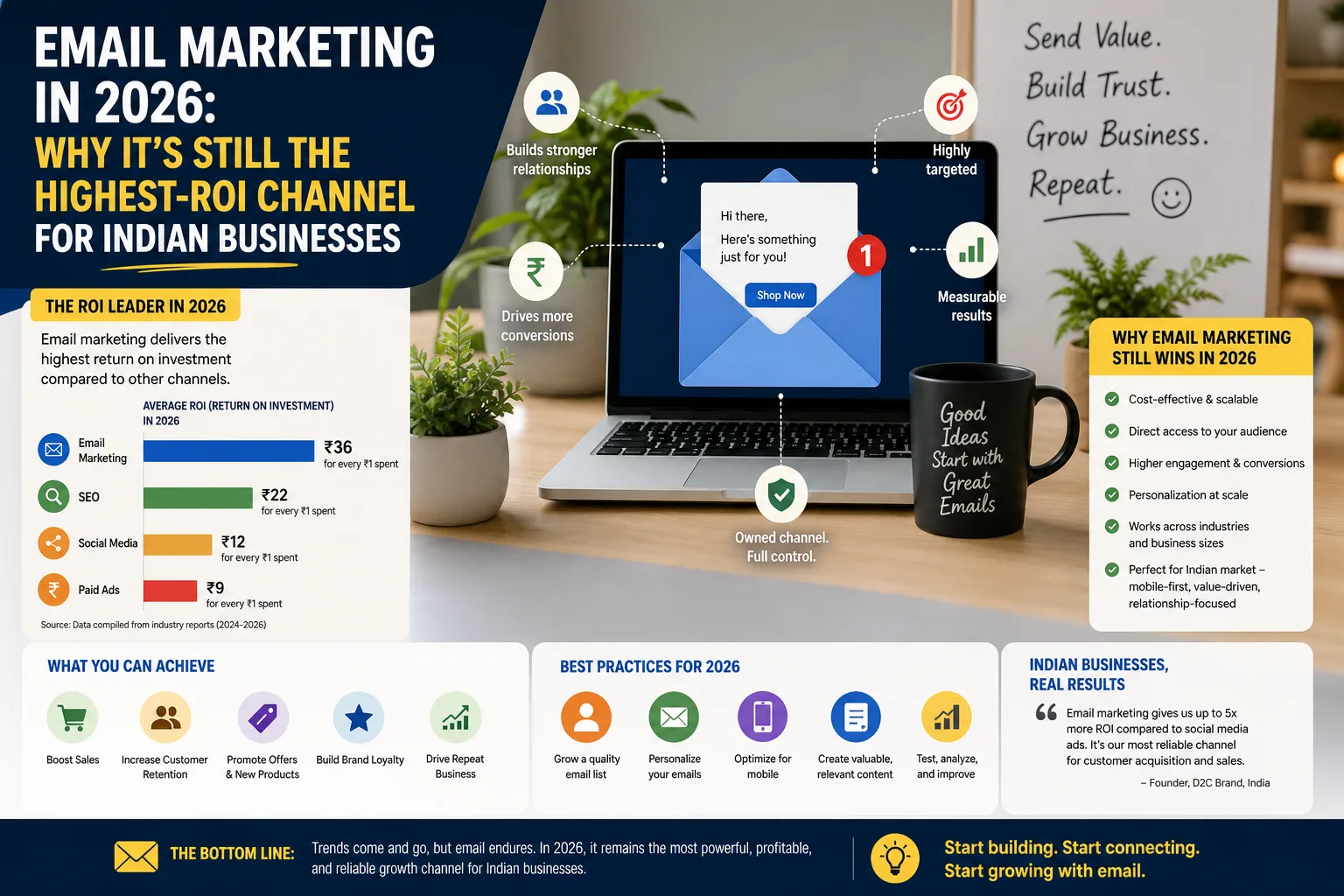
You may see statistics online claiming that email generates a specific amount of revenue for every ₹1 or $1 spent. These figures usually come from particular surveys, datasets, industries or marketing platforms and should not automatically be applied to every Indian business.
Email performance can vary considerably depending on:
- Industry
- Average order value
- Subscriber acquisition method
- List quality
- Offer and pricing
- Email frequency
- Deliverability
- Automation setup
- Customer lifecycle
- Attribution methodology
Instead of comparing email with SEO, social advertising or Google Ads using generic ROI percentages, calculate the economics of your own email programme.
How to Calculate Your Own Email Marketing ROI
A basic calculation is:
Email Marketing ROI = (Revenue Attributed to Email − Email Marketing Cost) ÷ Email Marketing Cost × 100
Your email marketing cost may include:
- Email-platform subscription
- Design and copywriting
- Staff or agency costs
- Landing-page tools
- Lead-generation costs
- Discounts or incentives used to acquire subscribers
- Technical and integration costs
Be careful with attribution. A customer may read an email, later search your brand on Google and then purchase. Depending on your analytics setup, different platforms may claim credit for the same sale.
For this reason, businesses should use consistent attribution rules rather than treating every sale associated with an email subscriber as email-generated revenue.
Build Your Email List With Permission
A sustainable email programme starts with people who have a legitimate reason to receive your messages.
Avoid purchasing random bulk email databases. A large list of people who never requested your marketing messages can create poor engagement, complaints and deliverability problems.
Instead, build your list through channels such as:
- Website signup forms: Invite visitors to receive useful updates, offers or content.
- Lead magnets: Offer a relevant guide, template, report or checklist in exchange for a voluntary signup.
- Customer accounts: Give customers a clear option to subscribe to marketing communications.
- Events and webinars: Allow participants to separately choose whether they want future marketing messages.
- Newsletter signup: Publish useful recurring content that gives visitors a reason to subscribe.
- Offline customers: Where appropriate, provide a transparent method for customers to opt in digitally.
Consent and Privacy Matter for Indian Businesses
Email addresses can constitute personal data, so businesses should treat subscriber information responsibly.
India's Digital Personal Data Protection Act provides that, where processing is based on consent, consent should be free, specific, informed, unconditional and unambiguous, with a clear affirmative action. It also provides for withdrawal of consent where consent is the basis for processing. Businesses should review the Act together with the rules and commencement provisions applicable to them at the time they implement their marketing programme.
In practical terms, an email signup should clearly explain what the person is signing up for rather than hiding marketing consent inside unrelated terms.
Your organisation should also have a process for handling unsubscribe requests and other applicable data rights.
Create a Useful Welcome Journey
When someone voluntarily subscribes, do not immediately overwhelm them with repeated promotions.
A simple welcome journey might include:
- Email 1: Confirm the signup and deliver whatever was promised.
- Email 2: Explain what your business does and who it helps.
- Email 3: Share a useful guide, product explanation or customer problem you can help solve.
- Email 4: Introduce a relevant product, service or next step.
The number and timing of emails should be tested for your own audience rather than following a universal formula.
Segment Instead of Sending Everything to Everyone
Segmentation allows you to send emails based on relevant customer characteristics or behaviour.
Useful segments might include:
- New subscribers
- Customers who have purchased
- Customers who purchased a particular product
- High-value customers
- Prospects who requested a demo or quotation
- Subscribers interested in a particular topic
- Inactive subscribers
For example, a person who downloaded a beginner's guide should not automatically receive the same message as an existing customer considering an advanced service.
Automations Worth Considering
Automation is most useful when an email is triggered by a meaningful customer action or stage rather than simply because software makes mass sending easy.
Welcome Automation
Triggered when someone voluntarily joins your email list. It can introduce your business and deliver the resource or information the person requested.
Lead Follow-Up
If someone submits an enquiry, downloads a relevant resource or requests information, an automated sequence can provide useful follow-up while allowing a salesperson to step in when necessary.
Abandoned Checkout or Cart
E-commerce businesses can remind customers about an incomplete checkout where their marketing and consent setup permits it.
Do not promise that abandoned-cart emails will recover a fixed percentage of lost sales. Track your own completed purchases and incremental revenue instead.
Post-Purchase Emails
These can include:
- Product instructions
- Usage tips
- Review requests
- Replenishment reminders
- Related-product recommendations
Re-Engagement
If subscribers have stopped interacting with your emails, you can test a re-engagement campaign asking whether they still want to receive your communications.
Continuously sending marketing emails to a large disengaged audience can also hurt list quality and sender reputation.
Deliverability Is as Important as Email Design
A well-written marketing email has little value if it repeatedly lands in spam.
Businesses should configure their sending domain properly and follow the requirements of major mailbox providers.
Google's Gmail sender requirements include email authentication requirements. Its current guidance tracks SPF and DKIM for senders and additional requirements such as DMARC and one-click unsubscribe for bulk senders. Google defines a bulk sender for this purpose as one sending about 5,000 or more messages to Gmail accounts within a 24-hour period.
Google also requires one-click unsubscribe for qualifying bulk marketing and promotional messages and recommends making it easy for recipients to stop receiving unwanted mail.
Email Authentication Basics
Your technical setup may include:
- SPF: Helps identify servers authorised to send email for your domain.
- DKIM: Adds cryptographic authentication to email messages.
- DMARC: Builds on SPF and DKIM and helps domain owners define how authentication failures should be handled.
If you use an email marketing platform, follow that provider's instructions for authenticating your domain rather than sending campaigns from an unconfigured address.
What Should You Measure?
Do not judge an email programme using a single metric.
Track a combination of:
| Metric | Why It Matters |
|---|---|
| Delivered emails | Shows how many messages successfully reached recipient mail systems. |
| Clicks | Indicates whether recipients are taking an action from the email. |
| Conversions | Measures completed purchases, enquiries, bookings or another defined business goal. |
| Revenue attributed to email | Helps assess commercial contribution when attribution is configured properly. |
| Unsubscribes | Can highlight whether recipients find your frequency or content relevant. |
| Spam complaints | Important for sender reputation and deliverability. |
| Email programme cost | Required for calculating your actual ROI. |
Google's Postmaster Tools can also provide information such as spam rates, domain reputation, IP reputation, authentication and delivery errors for qualifying Gmail traffic.
Choosing an Email Marketing Platform
There is no single best email marketing tool for every Indian business. Choose based on your audience size, automation requirements, integrations, sending volume, reporting needs and budget.
Mailchimp
Mailchimp provides email campaign, audience-management and marketing features and currently offers both free and paid marketing-plan options. Plan limits and pricing change, so businesses should check the current pricing page instead of relying on an old article's subscriber or send limits.
Brevo
Brevo combines marketing campaigns with features including transactional email, SMS, CRM and automation. Its current offering includes a free entry-level plan, although limits and paid-plan pricing should be checked before choosing it.
Kit
ConvertKit is now called Kit. It is positioned primarily for creators and newsletter businesses and provides email marketing, forms, landing pages and automation features.
ActiveCampaign
ActiveCampaign is more focused on businesses that require deeper marketing automation, segmentation, CRM-related workflows and multi-channel capabilities.
Klaviyo
Klaviyo is particularly focused on B2C and e-commerce marketing, combining customer data with email and other messaging capabilities. Its pricing scales with factors including profiles and channel usage.
Do not select a platform merely because it advertises a particular ROI figure. Test whether its pricing, integrations and capabilities match your actual business requirements.
A Simple Email Marketing Workflow for a Small Business
A business starting from scratch can keep the process simple:
- Define the audience: Decide who should receive your emails and why.
- Create a clear signup: Explain what subscribers will receive.
- Authenticate your domain: Configure the required email-authentication records.
- Create a welcome journey: Introduce the business and fulfil the subscriber's initial request.
- Segment the audience: Separate subscribers based on meaningful characteristics or actions.
- Send useful campaigns: Mix educational, product and commercial communications according to your audience's needs.
- Automate relevant journeys: Add welcome, follow-up, post-purchase or other workflows where they provide real value.
- Track conversions: Connect email activity with enquiries, sales or another meaningful business outcome.
- Review list quality: Monitor unsubscribes, complaints and inactive subscribers.
- Calculate your own ROI: Compare attributable business value with the actual cost of running the channel.
Common Email Marketing Mistakes
- Buying bulk email lists: A large database is not the same thing as an engaged audience.
- Sending without clear relevance: Subscribers should understand why they are receiving your emails.
- Sending the same message to everyone: Use segmentation when audience needs differ.
- Ignoring authentication: SPF, DKIM and DMARC configuration can be important for deliverability.
- Making unsubscribe difficult: Respect recipient choice and applicable provider and legal requirements.
- Obsessing over list size: A smaller relevant audience can be more valuable than a large disengaged database.
- Using generic ROI statistics as forecasts: Industry benchmarks are not guarantees for your business.
- Measuring only opens: Focus on downstream business outcomes such as clicks, qualified leads, purchases and revenue.
Can Email Marketing Be a High-ROI Channel?
Yes, email can become a commercially valuable channel when acquisition costs, platform costs and production costs remain reasonable relative to the business generated from subscribers.
But "high ROI" should be treated as an objective to measure rather than a guaranteed characteristic of email marketing.
A business with an engaged customer list, relevant offers and good automation may see very different economics from a new company sending generic newsletters to an unqualified audience.
Final Thoughts
Email marketing in 2026 is less about sending as many newsletters as possible and more about building a relevant, permission-based audience that your business can communicate with over time.
Start with a clear signup process, protect subscriber data, authenticate your sending domain, segment your audience and create emails that serve a defined customer need.
Most importantly, measure your own performance. Instead of assuming that email produces ₹36, ₹20 or any other fixed return for every ₹1 spent, calculate the revenue and business outcomes generated by your own programme against its actual cost.
For more practical digital marketing guides, explore our Marketing Insights section on BusinessTalks.in.
Disclaimer: This article provides general marketing information and should not be treated as legal or compliance advice. Privacy, consent and email-provider requirements may change. Businesses should review the latest applicable Indian law and the requirements of the email platforms and mailbox providers they use.