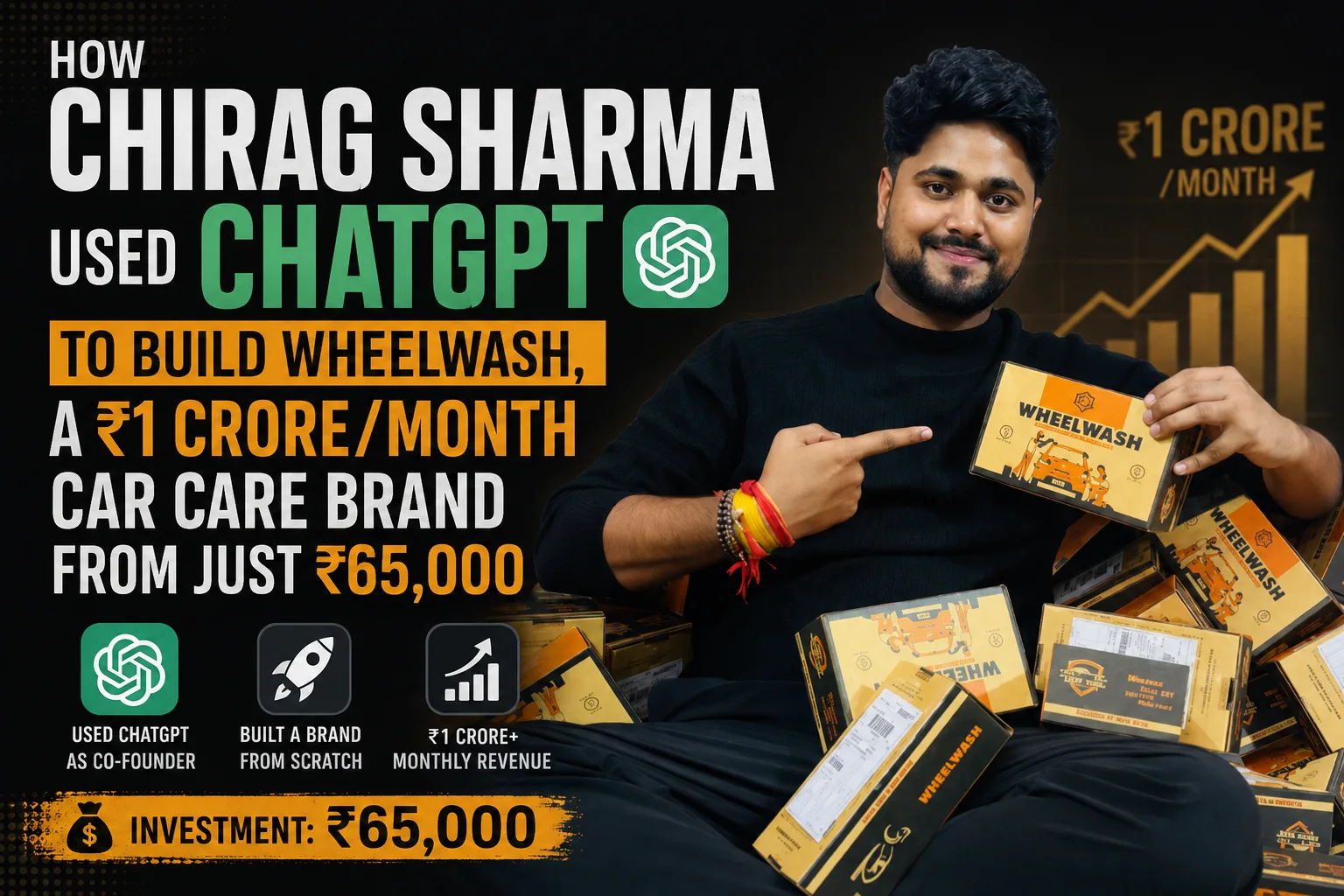
A 24-year-old from Aligarh shows how combining AI, curiosity, and focused execution can turn a small experiment into a multi-crore car care business.
Name: Chirag Sharma
Age: 24 (at the time of going viral)
Location: Aligarh, Uttar Pradesh, India
Brand: Wheelwash – a DIY car and bike care products brand, known especially for its scratch remover.
Who Is Chirag Sharma?
Chirag Sharma is a young entrepreneur from Aligarh, Uttar Pradesh, who became widely known online for building the car and bike care brand Wheelwash in his early twenties, with reported monthly revenue growing from tens of lakhs to around ₹1 crore by late 2025.
His story stands out because, lacking a chemistry background, he openly used ChatGPT to get a list of chemicals for a DIY scratch remover formula and to guide his early product and business decisions, starting with roughly ₹65,000 of his savings.
The Starting Point: A Simple Problem and Limited Money
Chirag noticed that many car owners wanted affordable DIY scratch-removal and cleaning solutions instead of paying high service-centre charges or unreliable local products.
With about ₹65,000 in savings, he could not build a lab or hire a big branding team, so he used ChatGPT as a fast research layer to understand basic formulation concepts and explore what kind of scratch remover could actually work in real-world conditions.
Using ChatGPT as a “Virtual Chemist” and Research Assistant
Instead of vague, one-line prompts, Chirag reportedly asked ChatGPT for detailed formulations and lists of chemicals that could be used in an effective car scratch remover, given that he did not understand the chemistry himself.
Rather than copying the AI output blindly, he:
- Got a list of potential chemicals and their roles from ChatGPT and used it as a starting point.
- Took those names to a manufacturer and chemical supplier in Aligarh to figure out sourcing and practical feasibility.
- Ran multiple trials and iterations to ensure the scratch remover worked and was safe to use on vehicle paint.
In other words, ChatGPT reduced his research time and gave structure, but offline testing, supplier discussions, and quality checks were still essential to getting a real product to market.
From Formulas to Products: Building the Wheelwash Line
After validating the scratch remover, Chirag gradually expanded Wheelwash into a more complete car and bike care brand, adding products like car shampoos, heat protectors, and care kits as demand grew.
Over multiple small batches and tests, he shaped a product range around:
- A DIY scratch remover that became the “hero product”, reportedly accounting for around 90–95% of sales at some points.
- pH‑conscious cleaning products for regular vehicle washing and shine.
- Complementary protectants and kits to increase average order value for customers.
Initial production volumes were modest and aligned with his bootstrapped budget, but customer feedback and reorders signalled that the scratch remover in particular had strong pull.
Marketing, Positioning, and the Brand Story
A big part of Wheelwash’s visibility came from combining product performance with a compelling founder story: a 24-year-old with no chemistry degree using ChatGPT to build a car scratch remover brand from Aligarh.
According to various posts and videos, Chirag leaned on:
- Raw, phone-shot before-and-after videos showing scratch removal and shine improvements.
- Short-form content explaining how he used a single ChatGPT prompt to get the initial formulation idea.
- Affordable pricing and bundles targeting DIY car owners across India through D2C and online channels.
The AI angle made his story shareable on startup pages and social media, while visible product results made customers willing to try and recommend Wheelwash.
Approximate Growth Snapshot
Public posts and interviews highlight Wheelwash’s progression from small experiments to multi-lakh and then crore-level monthly revenue. While exact figures vary by source, the pattern below summarizes what has been commonly reported.
| Phase | Time Period (approx.) | Key Milestone | Reported Monthly Revenue |
|---|---|---|---|
| Bootstrapping & Experiments | Late 2024 – Early 2025 | Used ChatGPT to get scratch remover formulation; launched early batches with ~₹65K capital. | Low multi‑lakh range (early traction, not widely disclosed). |
| Scaling the Hero Product | Mid – Late 2025 | Scratch remover drives a large majority of revenue; brand crosses tens of thousands of customers. | Around ₹60 lakh/month by November 2025. |
| Toward Crore-Level | December 2025 – Early 2026 | Reports indicate Wheelwash closing a month at ~₹1 crore revenue and serving 9,000+ customers in a single month. | ₹60 lakh to ~₹1 crore/month range (reported). |
Note: These numbers are based on publicly shared posts and may not represent audited financials, but they do show the general scale and momentum of the brand.
Visual Revenue Progression (HTML-Only Graph)
The simple bar-style visual below uses approximate numbers from public narratives to show how Wheelwash’s monthly revenue is said to have grown over time.
Bar widths are scaled relative to the reported ~₹1 crore month; they are meant to illustrate trajectory, not precise financial data.
Scaling Toward ₹1 Crore/Month
According to multiple posts and videos, Wheelwash’s revenue ramped up as the scratch remover became a hero product, new products were added, and content plus ads amplified reach, with November 2025 cited around ₹60 lakh and December targeted or reported at roughly ₹1 crore in monthly revenue.
The scale-up involved:
- Expanding distribution through D2C channels and online marketplaces to reach customers across India.
- Doubling down on short-form content, UGC-style demos, and social proof showing real scratch removal results.
- Letting the scratch remover drive most of the revenue while adjacent SKUs improved brand perception and upselling.
What began as a ₹65,000 AI-assisted formulation experiment thus evolved into a recognizable D2C car care brand in India, at least in terms of online visibility and reported revenue milestones.
What This Story Actually Shows About Using ChatGPT for Business
Chirag’s journey is often shared as an example that you do not need a formal chemistry degree or large funding to start a physical product brand, but you do need to ask precise questions, learn fast, test thoroughly, and execute consistently on marketing and sales.
In practical terms, his story underlines three key lessons:
- AI as a force multiplier: ChatGPT compressed his research time and helped him understand what to ask suppliers and manufacturers, but it did not replace real-world trials or quality control.
- Prompt quality matters: Detailed, context-rich prompts about scratch removers and car care unlocked more actionable insight than generic questions ever could.
- Story + results drive sales: The combination of a relatable founder narrative, AI-powered origin story, and visible product outcomes made people curious enough to buy and share.
For other founders in niches like car care, cleaning, cosmetics, or DIY tools, the Wheelwash story suggests that AI-assisted ideation plus disciplined execution can open big opportunities—if you stay honest about limitations, safety, and the need for real validation beyond the chat window.